


- All
- Product Name
- Product Keyword
- Product Model
- Product Summary
- Product Description
- Multi Field Search
Views: 0 Author: Site Editor Publish Time: 2026-06-01 Origin: Site
In the context of deepening enterprise digital transformation, wireless networks have become critical infrastructure for office operations, manufacturing, commercial services, and smart scenario development. As the core component of Wi-Fi networks, the selection of Wireless Access Points (APs) directly impacts network coverage quality, user access experience, and long-term maintenance costs.
In real-world projects, many network engineers tend to view indoor APs and outdoor APs simply as devices differing only in installation location. However, there are significant differences between them in terms of wireless design principles, hardware architecture, environmental adaptability, and network planning strategies. Incorrect selection can compromise coverage performance, shorten equipment lifespan, increase maintenance costs, and degrade user experience.
Therefore, at the early stage of wireless network construction, a thorough understanding of the design logic and application boundaries of indoor APs and outdoor APs is essential for building a high-quality wireless network.
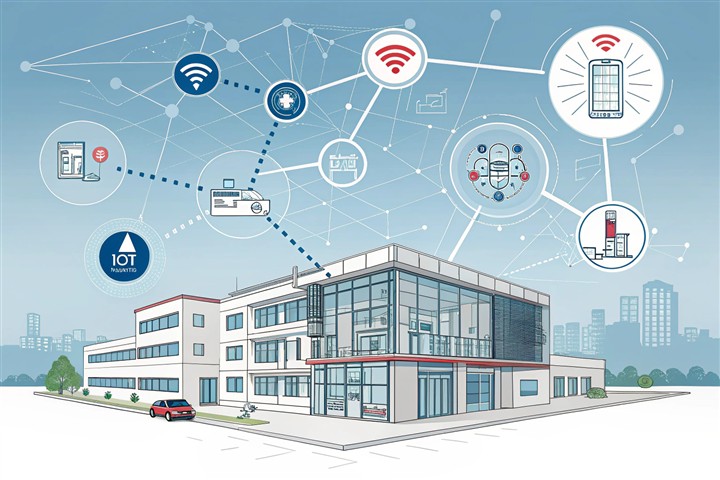
The primary function of a wireless access point is to convert wired networks into wireless networks, providing Wi-Fi connectivity for terminal devices. However, different environments impose vastly different requirements on wireless equipment, leading to two distinct product categories: indoor APs and outdoor APs.
Indoor Wireless Access Points Indoor APs are primarily deployed in enclosed building environments, such as office buildings, hotels, schools, hospitals, shopping malls, and various commercial spaces.
These environments typically feature:
· Complex spatial structures
· Numerous walls and partitions
· High user density
· Frequent roaming needs
· Relatively stable environmental conditions
Therefore, indoor AP design focuses on:
· Precision coverage
· High-density access capability
· Stable roaming experience
· Wireless interference control
· Optimization of space utilization efficiency
The goal is not maximum coverage distance, but to deliver balanced, efficient, and continuous wireless services within limited spaces.
Outdoor Wireless Access Points Outdoor APs are designed for open or semi-open environments, including:
· Campus roads
· Public squares
· Perimeter areas of stadiums
· Industrial factory zones
· Parking lots
· Warehousing and logistics parks
· Building exteriors
Compared with indoor environments, outdoor deployments face more uncertainties, such as:
· Rainfall
· Wind and sand
· UV exposure
· Temperature and humidity fluctuations
· Lightning induction
· Long-distance power supply and transmission
As a result, the core design focus of outdoor APs lies in environmental adaptability and long-term operational reliability, ensuring they can withstand the continuous challenges of complex natural conditions while maintaining coverage performance.
Environmental adaptability is the most fundamental distinction between the two types of devices.
Indoor APs Indoor devices are deployed in protected environments and typically operate under:
· Constant or near-constant temperature
· Low humidity variation
· No rain or snow exposure
· Minimal dust pollution
Their design is therefore lighter, emphasizing heat dissipation efficiency, aesthetic appearance, and ease of installation.
Outdoor APs Outdoor devices must endure prolonged exposure to natural environments. They usually feature:
· High-level dust and water protection
· Wide-temperature operation design
· Corrosion-resistant enclosures
· UV-resistant materials
· Lightning and surge protection
Common protection ratings reach IP65, IP66, or even higher standards to ensure stable long-term operation in harsh conditions.
Wireless signal propagation behaves completely differently indoors versus outdoors.
Indoor Coverage Characteristics Indoor environments contain many obstacles such as walls, ceilings, glass partitions, furniture, and electromagnetic interference sources. Wireless design prioritizes:
· Signal uniformity
· Roaming continuity
· Frequency reuse efficiency
· Co-channel interference control
Coverage planning is typically carried out at the room, floor, and functional area levels with high precision.
Outdoor Coverage Characteristics Outdoor environments have fewer obstacles but larger coverage areas. Design emphasis shifts to:
· Coverage distance
· Coverage angle
· Installation height
· Directional propagation
· Blind spot control
In large campuses or open areas, directional antennas and sector antennas are often used to achieve long-distance coverage and capacity optimization.
The antenna system directly determines wireless coverage quality.
Indoor AP Antenna Design Indoor APs typically use:
· Built-in omnidirectional antennas
· Smart antenna arrays
· Multi-stream MIMO designs
The main objectives are room-level coverage, floor-level roaming, and multi-terminal concurrent access. Coverage is relatively controlled to avoid excessive signal spillover and interference.
Outdoor AP Antenna Design Outdoor deployments emphasize flexibility. Common options include:
· External high-gain antennas
· Omnidirectional antennas
· Directional antennas
· Sector antennas
These enable wide-area coverage, long-distance transmission, point-to-multipoint connections, and precise coverage of specific areas.
User behavior patterns in different scenarios determine the wireless network design approach.
Indoor Scenarios Typical applications include enterprise offices, training sessions, healthcare services, and retail. Characteristics include:
· Concentrated user numbers
· Longer online times
· High requirements for service continuity
· High proportion of video conferencing and cloud applications
Focus areas: concurrent client capacity, spectrum utilization, roaming handover performance, and QoS policies.
Outdoor Scenarios Typical applications include campus mobile work, outdoor activities, logistics operations, and industrial inspections. User behavior is more dynamic:
· Frequent movement
· Dispersed access distribution
· Significant traffic fluctuations
Network planning must balance coverage range and capacity.
Indoor AP Deployment Installation is relatively simple (ceiling-mounted, wall-mounted, concealed cabling). Maintenance staff can access devices quickly, resulting in short construction periods, low O&M costs, and easy fault location.
Outdoor AP Deployment Deployment often involves pole mounting, high-altitude work, waterproof cabling, grounding systems, and lightning protection configurations. Maintenance must account for weather conditions, high-altitude repairs, and site accessibility, leading to significantly higher overall construction and O&M costs.
Prioritize Selection Based on Actual Environment The most important principle in wireless network construction is: Devices should adapt to the environment, not the other way around.
· Use indoor APs for primarily enclosed building areas.
· Use outdoor APs for areas exposed to natural elements for extended periods.
· For semi-open areas such as lobbies, corridors, and loading platforms, conduct a comprehensive assessment considering sun/rain exposure, installation location, and coverage requirements.
Capacity Planning Based on Business Needs Different business scenarios require different network models. For example:
· Office areas focus on concurrent access capacity
· Hotels emphasize seamless roaming
· Industrial scenarios require stable terminal connectivity
· Campuses need both coverage and high-density support
AP selection must satisfy both coverage and service-bearing requirements.
Consider Future Scalability Enterprise networks are long-term investments. When selecting equipment, consider user growth, business expansion, network upgrades, and new scenario access. Products with unified management platforms, centralized control, and flexible expansion capabilities can effectively reduce future renovation costs.
Hybrid Deployment Has Become the Mainstream Approach With the development of campus-style and smart projects, more initiatives require both indoor and outdoor coverage. Typical cases include enterprise headquarters campuses, luxury hotels, smart schools, industrial manufacturing bases, and medical parks.
A hybrid architecture using both indoor and outdoor APs enables:
· Full-scenario wireless coverage
· Unified network management
· Continuous roaming experience
· Higher resource utilization
· Greater flexibility for expansion
Using indoor APs in outdoor environments may cause shell aging, component damage, increased failure rates, and shortened lifespan. Conversely, deploying outdoor APs in complex indoor environments can lead to uneven coverage, severe signal spillover, increased interference, degraded roaming performance, and difficult capacity planning.
There is no absolute superiority between indoor wireless access points and outdoor wireless access points. They are specialized devices designed for different deployment environments.
From environmental adaptability, coverage models, and antenna architecture to installation and maintenance methods, the two exhibit clear differences. For enterprise wireless networks, what truly determines quality is not device specifications alone, but the degree of matching between device capabilities and actual scenarios.
During wireless network planning, comprehensively evaluate deployment environment, user behavior, capacity requirements, expansion plans, and O&M conditions. For projects involving both indoor and outdoor areas, a hybrid deployment strategy typically delivers better coverage, more stable network experience, and higher long-term investment value.

