


- All
- Product Name
- Product Keyword
- Product Model
- Product Summary
- Product Description
- Multi Field Search
Views: 0 Author: Site Editor Publish Time: 2026-07-16 Origin: Site
In the current era of full-scale digitalization, data centers have long become the "core foundation" of the digital economy. Behind all digital behaviors such as short video browsing, online transactions, cloud computing scheduling, big data storage, and artificial intelligence computing, the 7× 24-hour uninterrupted stable operation of data centers is indispensable.
When most people pay attention to data centers, their focus is on explicit indicators such as computing power scale, power supply reliability, cooling efficiency, and network bandwidth, but they often overlook a core element that is invisible and intangible but determines the lifespan and stability of the computer room - environmental cleanliness.
Many operation and maintenance misunderstandings hold that as long as the computer room is regularly swept and the equipment wiped, it is clean. But in fact, for precision IT equipment, the real threat is not the dust and debris visible to the naked eye, but the suspended particles and dust pollutants at the micrometer level. Even a seemingly clean computer room, the long-term accumulation of fine dust can cause a series of fatal problems such as equipment failure, performance degradation and sudden downtime. Today, we will delve deeply into why cleanliness is an indispensable fundamental lifeline in data centers.
Unlike the cleanliness standards of ordinary office Spaces, the cleanliness of data centers specifically refers to the control level of particulate matter in the air of the computer room and on the surface of equipment. The core control is for suspended particles ≥0.5μm, which is also the core detection index of the ISO 14644 data center cleanliness standard. The mainstream industry norms stipulate that the main computer room of a standard data center must meet the 8.7-level clean standard and strictly limit the concentration of ultrafine particulate matter in the air.
These ultrafine dusts have a wide range of sources: outdoor dust brought in by fresh air, hair and fine dust carried by people entering and leaving, slight shedding from the cable shells of cabinets, accumulated dust in the floor interlayers and ceiling gaps, and debris produced by the friction of equipment operation, etc. They float in the air and are imperceptible to the naked eye, but they can enter the internal core components of servers, switches and storage devices with the airflow, posing multiple safety hazards.
More importantly, dust pollution is cumulative, concealed and irreversible. It may not show any abnormalities in the short term, but it will continuously erode equipment over the long term, eventually evolving from a minor hazard into a major operation and maintenance accident.
Many data center malfunctions eventually point to the overlooked issue of cleanliness. The harm of ultrafine dust to data centers spans all dimensions, including equipment operation, energy consumption cost, operation and maintenance security, and asset lifespan. Each of these aspects directly affects the core operational indicators of the computer room.
Data center equipment relies on air-cooling circulation to achieve continuous heat dissipation. Server fans, heat dissipation fins, and ventilation pores are the core channels for heat dissipation. When ultrafine dust adheres and accumulates, it will form a dense "heat insulation layer" on the surface of the equipment, directly blocking the ventilation channels and significantly reducing the heat dissipation efficiency.
Poor heat dissipation can cause the internal temperature of the device to continuously rise, triggering the chip to reduce frequency and performance lag. In severe cases, it can directly lead to hardware overheating and restart, as well as instantaneous system crashes. At the same time, the increased heat dissipation pressure will also force the HVAC cooling system in the computer room to operate at high load, significantly increasing ineffective energy consumption and directly raising the PUE value of the data center, resulting in continuous energy waste.
The server motherboard, chips, capacitors, interfaces and other precision electronic components have extremely small circuit gaps and are highly sensitive to environmental cleanliness. Conductive dust and metal shavings adhering to the surface of circuit boards will directly reduce the electrical clearance. Under the normal temperature and humidity conditions of the computer room, the conductivity of dust increases significantly after absorbing moisture, which can easily cause problems such as micro-short circuits, leakage, and arc breakdown, directly burning out chips and circuit boards.
In addition, long-term accumulation of dust will accelerate the aging of the insulation layer of the circuit board and the oxidation and corrosion of metal interfaces, leading to a decline in the insulation performance of the equipment, poor contact, and intermittent faults. Such hidden faults are extremely difficult to troubleshoot. They often consume a great deal of manpower and material resources, but it is hard to quickly locate the root cause, which seriously affects the efficiency of operation and maintenance.
Traditional mechanical hard disks, server fans, bearings and other high-speed rotating precision components are extremely sensitive to environmental particulate matter. Suspended dust entering the interior of the equipment will intensify the frictional wear of high-speed rotating components. Data shows that the overall service life of IT equipment in computer rooms that do not meet cleanliness standards will be shortened from the standard 5 to 7 years to 3 to 4 years, and the depreciation of assets will increase by 40% to 50%.
Dust accumulation and jamming of the fan can lead to continuous deterioration of the equipment's heat dissipation. Particles adhering to the hard disk head and the disk surface can cause head collisions, read and write errors, and frequent bad sectors, ultimately resulting in abnormal data reading or even data loss, directly threatening data integrity and business continuity.
The dry and dusty environment of the computer room is a breeding ground for static electricity. The continuous accumulation of dust will reduce the insulation of the equipment surface and intensify the accumulation of static electricity. The high-voltage pulses generated instantaneously by electrostatic discharge can break down precision electronic components, interfere with the signal transmission of equipment, and cause sudden problems such as network packet loss, service interruption, and equipment freeze. This type of malfunction is highly random and has no fixed pattern, making it one of the most difficult risks to control in the operation and maintenance of data centers.
Most operation and maintenance teams underestimate the control of cleanliness. Essentially, they only see the "cleaning cost" and ignore the "huge hidden losses caused by pollution". The losses caused by the loss of control over cleanliness far exceed the daily investment in clean operation and maintenance.
Premature aging and frequent malfunctions of equipment mean a significant increase in the frequency of hardware replacement and component maintenance. For medium and large-sized data centers, the premature scrapping of a batch of servers and network equipment will result in an additional asset investment of hundreds of thousands or even millions of yuan each year, significantly raising the operating costs of the data center.
The financial, e-commerce, government affairs and Internet businesses carried by data centers have extremely high requirements for availability. Even a sudden outage within minutes can lead to business suspension, user loss, transaction losses, and in severe cases, data errors, information loss, compliance risks, and damage to brand reputation.
All kinds of hidden faults caused by dust require continuous investigation, repair and debugging by operation and maintenance personnel, which greatly increases the pressure on human operation and maintenance. At the same time, the sharp increase in cooling energy consumption caused by heat dissipation failure will keep the computer room in a high PUE operating state for a long time. The accumulated power loss over time is a huge expense.
Cleanliness has never been an optional optimization item, but rather an essential requirement for the compliant operation of data centers. The currently widely used ISO 14644 cleanroom standard in the industry clearly incorporates air cleanliness, particulate matter control, and environmental purification into the core norms for data center operation and maintenance.
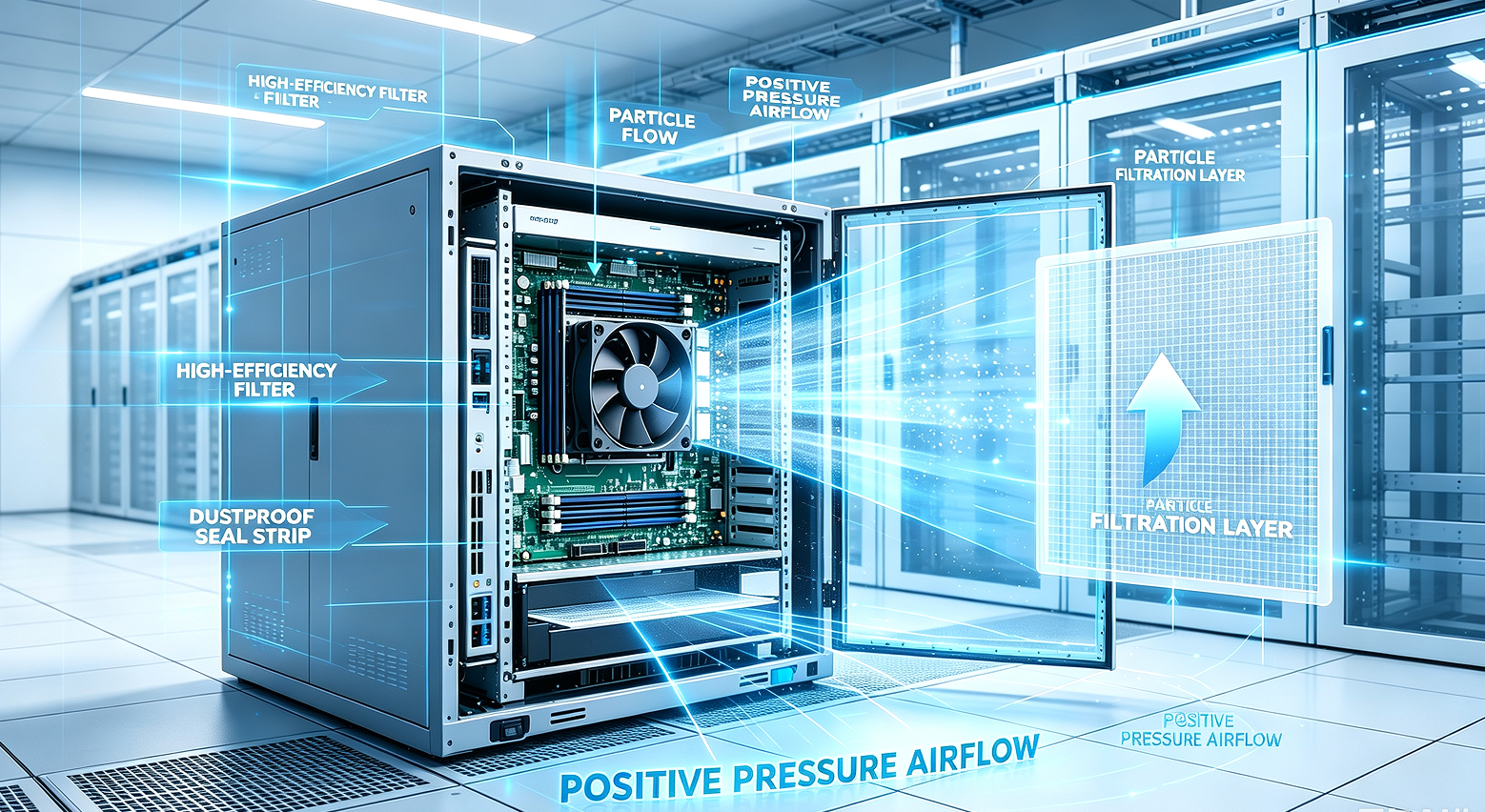
The main computer room of the standard computer room strictly adheres to the 8.7-level clean standard, precisely controlling the number of suspended particles larger than 0.5μm. At the same time, it requires the computer room to maintain a positive pressure environment and prevent the intrusion of external dust through air flow blocking. In addition, cleanliness testing is an important part of the acceptance of computer rooms, operation and maintenance inspection, qualification review, and equipment warranty verification. If the cleanliness does not meet the standards, not only will the industry compliance inspection not be passed, but the original factory warranty rights of the equipment may also be directly invalidated.
The cleanliness control of data centers is not a one-time cleaning task, but a regular and systematic environmental operation and maintenance project. The core is implemented around four dimensions: "controlling the source, preventing intrusion, frequent purification, and regular detection".
1. Source control and dust prevention: Strictly enforce personnel entry and exit management, wear dust-proof clothing, and reduce the frequency of opening the computer room door. Seal the gaps in the ceiling, floor and pipelines to eliminate dust accumulation dead corners. Select low-shedding and dust-proof building materials and equipment for the computer room.
2. Fresh air filtration and purification: High-efficiency filters are configured in stages, and the HVAC system filter elements are replaced regularly to precisely intercept ultra-fine suspended particles, avoiding the problem that ordinary filters cannot intercept sub-micron dust.
3. Regular deep cleaning: Not only clean the surface of the equipment, but also focus on cleaning hidden dust-accumulating areas such as floor interlayers, the interior of cabinets, ventilation ducts, and heat dissipation fins to prevent dust accumulation.
4. Regular quantitative detection: Use particle counters to conduct grid-based spot checks, record particulate matter data, compare it with historical baselines, promptly identify attenuation issues of the purification system, predict risks in advance, and optimize operation and maintenance plans.
Computing power, power supply and cooling determine the upper limit of data center operation, while cleanliness determines the lower limit of data center operation.
The seemingly insignificant micron-level dust is the core hidden killer of equipment aging, downtime, soaring energy consumption and asset depreciation. A high-standard clean environment is not an added bonus for meticulous operation and maintenance, but a fundamental and essential need for data centers to ensure business continuity, reduce operating costs, extend equipment lifespan, and safeguard data security.
In the current industry context where high availability, low PUE, and long lifespan are pursued to the extreme, emphasizing cleanliness control and establishing a regular purification operation and maintenance system are the best solutions for data centers to reduce costs, increase efficiency, and ensure stable and long-term operation.

