


- All
- Product Name
- Product Keyword
- Product Model
- Product Summary
- Product Description
- Multi Field Search
Views: 0 Author: Site Editor Publish Time: 2026-07-08 Origin: Site
Messy, disorganized cabling is one of the most common pain points in data centers, server rooms, industrial control rooms and office wiring closets. Unmanaged cables lead to signal interference, difficult troubleshooting, poor heat dissipation, accidental cable damage, extended maintenance downtime and even hidden safety hazards.
Two mainstream cable management architectures dominate modern deployment: open cable management and closed cable management. Neither is universally superior—each carries unique strengths, limitations and applicable scenarios. This article systematically compares open and closed wiring systems, shares actionable optimization strategies, and provides a clear decision framework to help you build neat, stable, easy-to-maintain cable layout systems.
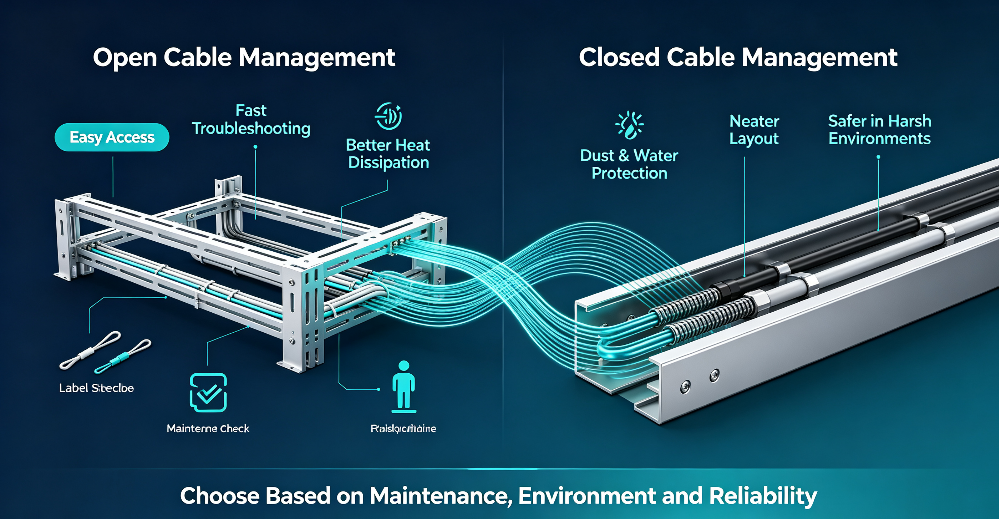
Open cable management refers to exposed, unenclosed cable routing solutions, including open cable trays, wire ladders, vertical cable racks, cable rings, plastic cable ties and horizontal open wire channels. All fiber, copper patch cords and trunk cables are fully visible without metal or plastic cover enclosures.
It is widely adopted in large data centers, high-density server racks, temporary computer rooms and equipment testing workshops.
Closed cable management uses fully enclosed sealed structures to wrap all cables, such as enclosed metal cable troughs, sealed PVC wire ducts, underground buried conduits, wall-mounted closed trunking and sealed rack cable boxes. Cables are completely isolated from the external environment with full coverage shells.
This scheme is standard for office integrated wiring, factory production workshops, outdoor wiring, public building corridors and high-dust/humidity harsh environments.
- Open Management Advantage: Full cable visibility. Technicians can quickly locate faulty lines, identify labeled fiber jumpers, add or replace cables without removing covers. Ideal for frequent equipment expansion, daily network upgrades and rapid fault repair.
- Closed Management Disadvantage: Requires disassembly of duct covers to access internal wires. Troubleshooting and cable modification consume more labor time; frequent opening will reduce sealing performance.
- Open Management Advantage: Maximum air circulation around cables. Significantly reduces heat accumulation for high-power 400G/800G fiber links and Cat6A/Cat8 high-speed copper cables, lowering transmission loss and extending cable service life. Critical for high-density data center racks.
- Closed Management Disadvantage: Poor air convection inside sealed troughs. Heat buildup risks signal attenuation, and long-term high temperature accelerates sheath aging. Extra heat dissipation measures are required for high-bandwidth cabling.
- Closed Management Advantage: Full physical isolation. Blocks dust, water vapor, corrosive gas, mechanical collision, rodent biting and accidental pulling. Perfect for industrial workshops, outdoor corridors, underground wiring and public areas with high human activity.
- Open Management Disadvantage: Exposed cables face risks of dust accumulation, accidental scratching, liquid splashing and animal damage. Regular cleaning is mandatory to avoid signal short-circuit or fiber scratch failure.
- Open Management: Highly flexible layout. Supports horizontal/vertical cross wiring, adjustable cable rings, layered separation of fiber and power cables. Easy to expand cable capacity later without reconstructing the entire routing channel.
- Closed Management: Fixed internal space. Once installed, duct capacity cannot be expanded; additional cables require new closed trough laying, raising reconstruction costs and construction cycles.
- Open Management: Low material cost for wire ladders and open trays; fast installation, simple cutting and assembly. Low labor cost for later expansion.
- Closed Management: Higher cost of sealed metal/PVC ducts; complicated cutting, sealing and joint treatment during installation. Modification and expansion bring extra material and labor expenses.
- Closed cable management delivers neat, uniform hidden wiring for office and commercial buildings, meeting architectural decoration standards.
- Open cable layout looks industrial and minimalist, acceptable for back-end equipment rooms but not suitable for public visible areas.
1. Large & medium data centers with high-density optical/electrical wiring
2. Server equipment rooms requiring frequent network expansion and equipment replacement
3. Test laboratories, temporary project computer rooms and containerized edge computing stations
4. Indoor machine rooms with constant temperature, low dust and dry environment
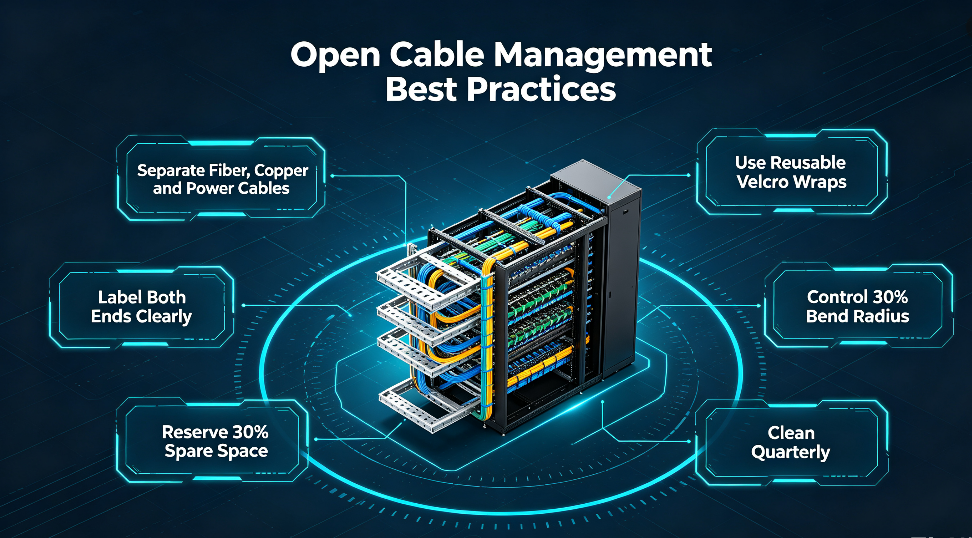
1. Separate fiber cables, data copper cables and power supply cables into independent layered open trays to eliminate electromagnetic interference.
2. Use reusable velcro cable wraps instead of plastic zip ties to avoid sheath crushing during thermal expansion.
3. Standardize unified cable labeling: mark both ends of each jumper with equipment port, transmission bandwidth and cable length.
4. Reserve 30% spare space in open wire ladders for future project expansion, avoid overfilling.
5. Install vertical cable management racks at rack sides to organize vertical trunk lines, prevent cable sagging and excessive bending loss of optical fibers.
6. Schedule quarterly dust cleaning for exposed cables to reduce dust-induced signal attenuation.
1. Office buildings, shopping malls and public office visible corridors
2. Manufacturing workshops with dust, oil mist, corrosive chemicals and vibration
3. Outdoor wall wiring, underground buried network trunk lines and weak current wells
4. Schools, hospitals and public spaces with high pedestrian flow to prevent accidental cable damage
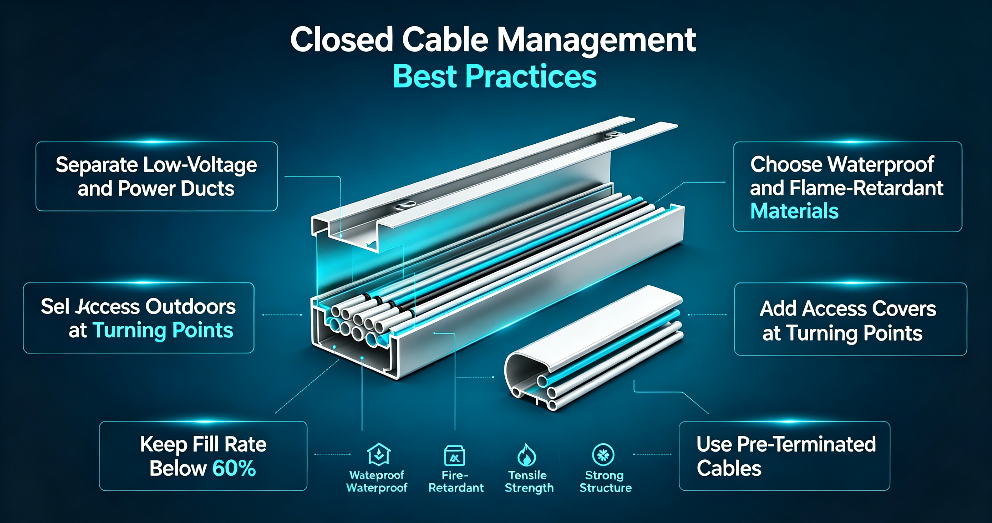
1. Strictly separate weak current network ducts and strong current power ducts with independent closed troughs, maintain over 30cm distance to avoid EMI interference.
2. Select waterproof, flame-retardant, anti-corrosion PVC or galvanized metal closed ducts based on ambient temperature and humidity.
3. Leave sufficient reserved wire holes and maintenance access covers at every turning point and equipment junction for later inspection.
4. Avoid overcrowding closed ducts; fill rate shall not exceed 60% to reserve heat dissipation space.
5. Seal all duct joints, wire inlet and outlet points with waterproof rubber strips for outdoor or humid indoor environments.
6. Use pre-terminated standard fiber cables to reduce on-site cable stripping inside closed troughs, lower hidden failure risks.
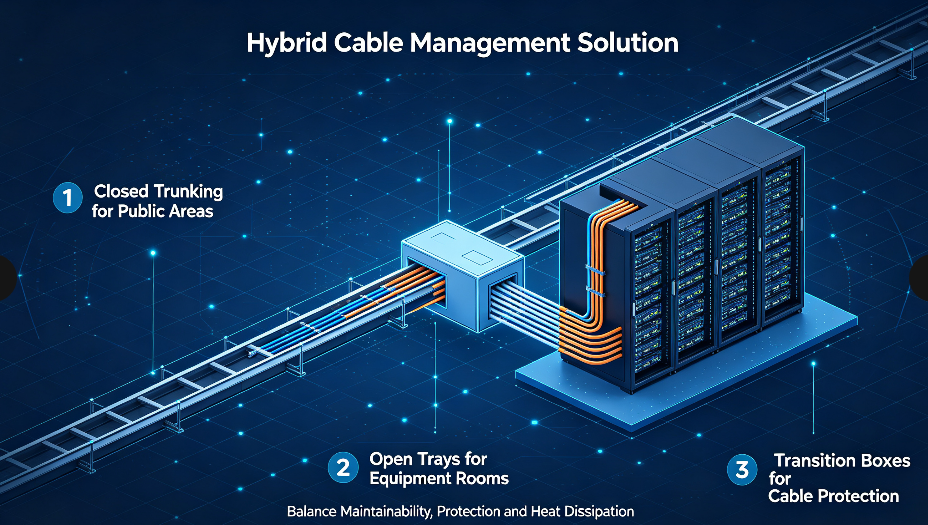
Most modern comprehensive wiring projects do not fully rely on a single system. A hybrid open+closed layout balances maintainability and environmental protection, which is the optimal optimization scheme for most projects:
1. Closed sealed ducts for public visible corridors, factory production areas and outdoor trunk lines to isolate harsh environments.
2. Open wire ladder and vertical cable racks inside independent equipment rooms and data center areas for convenient maintenance and heat dissipation.
3. Transition boxes at the junction of open and closed channels to organize cable entry and protect fiber bending radius.
4. Unified global labeling standards run through both open and closed sections to realize full lifecycle cable traceability.
1. Control fiber bending radius strictly: single-mode/multi-mode fiber cables shall not be bent below the specified minimum radius to avoid increased insertion loss.
2. Classify cables by service type: split 400G/800G high-speed fiber, ordinary OM4 fiber, Cat8 high-frequency copper and low-speed patch cords into different routing channels.
3. Avoid excessive cable tension: reserve loose margin at rack inlet and outlet to prevent fiber core breakage caused by equipment vibration.
4. Adopt color-coded cable identification: use different sheath colors for core backbone, horizontal distribution and equipment jumpers to improve identification efficiency.
5. Regular quarterly inspection: check sheath aging, loose joints, overheating and label fading risks in both open trays and closed troughs.
Open cable management focuses on maintainability, heat dissipation and flexible expansion, making it the top choice for data centers and dedicated equipment rooms with stable indoor environments. Closed cable management prioritizes cable protection, safety and visual aesthetics, perfectly matching offices, factories and outdoor harsh wiring scenarios.
The best network cable optimization strategy is not a one-size-fits-all solution. Evaluate environmental conditions, equipment update frequency, maintenance workload and budget first, then select pure open, pure closed or hybrid mixed wiring systems to achieve orderly, low-loss, long-lifecycle network cable management.

