


- All
- Product Name
- Product Keyword
- Product Model
- Product Summary
- Product Description
- Multi Field Search
Views: 0 Author: Site Editor Publish Time: 2026-07-24 Origin: Site
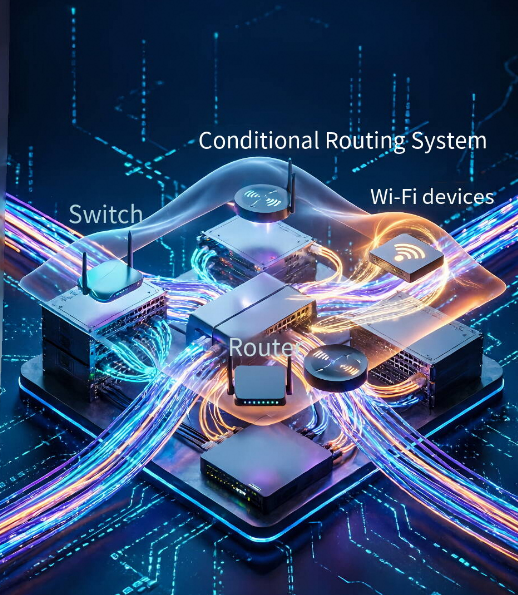
The network structure is an interconnected grid of network devices (including access points, switches and routers), which enables data to be transmitted efficiently to the destination. Although the term "structure" can refer to physical cabling and connection, it usually indicates a virtualized, automated overlay connection network located on top of a physical network topology. This virtualization framework enhances scalability, flexibility and efficiency, thereby achieving a dynamic and highly adaptable network environment.
The network structure consists of two key components: the physical layer (the lower layer) and the virtualization layer (overlay). The bottom layer includes switches, routers and Wi-Fi devices, providing a simple, scalable and powerful foundation for communication between devices.
The virtualization overlay is where user data is transmitted. By adding specific headers to data packets, network devices can interpret these headers to block or allow data packets, thereby effectively creating conditional routing systems. This makes it seem as if there is a separate network, connected only to a group of devices indicated by the header.
Virtualization adds significant value by dividing the underlying layer into multiple overlay networks. Each virtual network can be independently optimized through different strategies to meet various needs.
In addition, the network structure adopts a wide range of policy-based control and automation mechanisms, enabling it to quickly adapt to changes in accordance with business requirements. This combination of virtualization, policy control and automation enables the construction of data centers to achieve efficient, flexible and responsive network infrastructure.
Modern enterprises rely heavily on their networks, not only for connection but also for verifying user identities, protecting sensitive data and ensuring a good user experience. Due to the wide variety of users (such as managers, employees, security guards, contractors and guests), as well as various Internet of Things devices (such as cameras, door locks and temperature controllers), a powerful network structure is crucial for the construction of data centers.
The network structure enables enterprises to uniformly apply policies independently of the underlying physical network, thus allowing them to meet the needs of their diverse user groups. This is crucial for different access types (whether wired or wireless) and for a wide range of applications that support everything from financial systems to CRM and sales software.
By integrating network structures in campus, branch offices, WAN and data center networks (including hybrid setups), enterprises can create seamless enterprise-wide structures. This integration can ensure the coherence and efficiency of the network infrastructure, thereby enhancing the performance, security and manageability of the entire enterprise network.
The network structure has the following advantages:
· Simplify deployment and operation: Create virtualized planes by abstracted basic physical topologies and network structures, thereby simplifying deployment and continuous operation. This abstraction layer simplifies network management, reduces complexity and operational costs.
· Unified policy implementation: The network structure can uniformly apply services and implement policies on both wired and wireless users and devices. Regardless of the connection or device type, this can ensure consistent security, performance and access control.
· Enhanced security: By restricting traffic propagation and containing threats, the network structure can significantly reduce business risks and improve overall security. This containment strategy helps to quickly identify and isolate security vulnerabilities, minimizing potential damage.
· Scalability: The network structure is built using standardized building blocks, which enables the network to be easily expanded as the organization's requirements grow. This modular approach ensures that the network can adapt to the growing demands without the need for a thorough overhaul.
Due to these remarkable advantages, network structures are widely adopted in many enterprise networks.
Network architecture technology is transforming modern enterprise networks by creating interconnected networks of devices such as switches, routers and access points. This approach enhances scalability, flexibility and security through a two-tier structure composed of a physical base layer and a virtualization overlay layer. Therefore, an increasing number of enterprises are adopting network structures to meet the demands of modern applications and diverse users, creating more cohesive, secure and adaptable network infrastructure in data center construction.

