


- All
- Product Name
- Product Keyword
- Product Model
- Product Summary
- Product Description
- Multi Field Search
Views: 0 Author: Site Editor Publish Time: 2026-06-11 Origin: Site
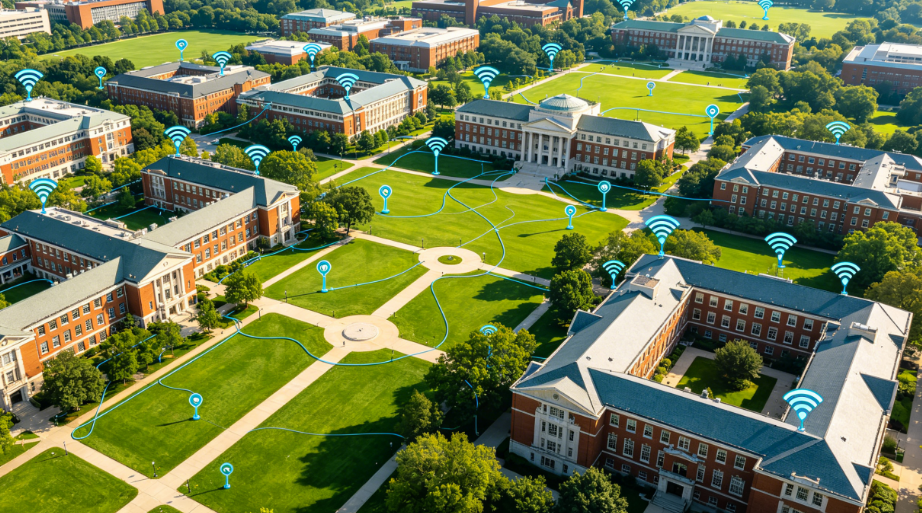
Campuses, parks, and large-area developments (e.g., industrial parks, residential complexes) require reliable, high-speed network coverage that can span long distances, withstand harsh outdoor conditions, and support multiple users and devices. Outdoor fiber cabling is the ideal solution for these applications, offering superior bandwidth, longer transmission distances, and greater durability than copper cables. As a structured cabling supplier with expertise in outdoor network solutions, we break down the key considerations, best practices, and solutions for outdoor fiber cabling in campuses, parks, and large areas.
Outdoor large-area networks (e.g., campuses, parks) have unique demands—long distances, exposure to harsh conditions, and high device density. Fiber optic cabling outperforms copper cables in these scenarios for three key reasons:
- Immunity to EMI: Unlike copper cables, fiber transmits data via light signals, which are not affected by electromagnetic interference (EMI) from power lines, industrial equipment, or other electronic devices—critical for outdoor environments where these sources are common.
- Longer Transmission Distances: Single-mode fiber (SM) supports transmission distances up to 100km without signal degradation, eliminating the need for costly repeaters—ideal for large areas like university campuses or industrial parks.
- Durability & Size: Fiber cables are thinner, lighter, and more durable than copper, making them easier to install in outdoor spaces (e.g., underground, overhead) without disrupting the environment or requiring heavy equipment.
The first step in designing an outdoor fiber cabling system is selecting the right fiber type—single-mode (SM) or multi-mode (MM)—based on your project’s distance and bandwidth needs:
- Single-Mode (SM) Fiber: The preferred choice for large-area coverage (e.g., university campuses, city parks, industrial parks). SM fiber has a narrow 9μm core, supports speeds up to 100Gbps, and transmits data up to 100km—perfect for connecting distant buildings, Wi-Fi hotspots, or surveillance cameras.
- Multi-Mode (MM) Fiber: Suitable for shorter distances (up to 550m), such as connecting buildings within a small campus or park. MM fiber (50/125μm or 62.5/125μm core sizes) is cost-effective for local connections and supports high bandwidth for IoT devices or video surveillance.
Our outdoor fiber cables are available in both SM and MM options, with core sizes tailored to your specific distance and bandwidth requirements.
Outdoor fiber cables must withstand extreme temperatures (-40°C to 85°C), moisture, UV radiation, abrasion, and even rodent damage. We offer two main types of outdoor fiber cables, each designed for specific installation environments:
- GYTS (Loose Tube Stranded) Cables: Features a steel tape armor layer, making them ideal for underground installation (direct burial). The armor resists rodent damage and mechanical stress, ensuring long-term reliability in parks, campuses, or industrial areas.
- GYFTZY (Non-Metallic Loose Tube) Cables: Lightweight and non-metallic, making them perfect for overhead installation (on poles) or areas where electrical conductivity is a concern (e.g., near power lines). GYFTZY cables are also easier to install in urban areas where aesthetic or safety considerations are paramount.
Both types feature LSZH or PE jackets that are UV-resistant and waterproof—ensuring performance in even the harshest outdoor conditions.
Installation methods for outdoor fiber cabling depend on your project’s environment, budget, and aesthetic needs. The three most common methods are:
- Direct Burial: Ideal for parks, campuses, and industrial parks where trenching is feasible. Cables are buried 60-80cm deep, with a layer of sand or protective conduit to prevent damage from digging or rodents. GYTS cables are recommended for direct burial due to their armor protection.
- Overhead Installation: Used when trenching is not possible (e.g., across roads, rivers, or existing structures). Cables are strung between poles using messenger wires to support the cable weight and prevent sagging. GYFTZY cables are preferred for overhead installation due to their lightweight and non-metallic design.
- Conduit Installation: Cables are run through PVC or HDPE conduits, providing additional protection against moisture, abrasion, and damage. This method is ideal for urban areas (e.g., city parks, campus walkways) where aesthetics and safety are top priorities.
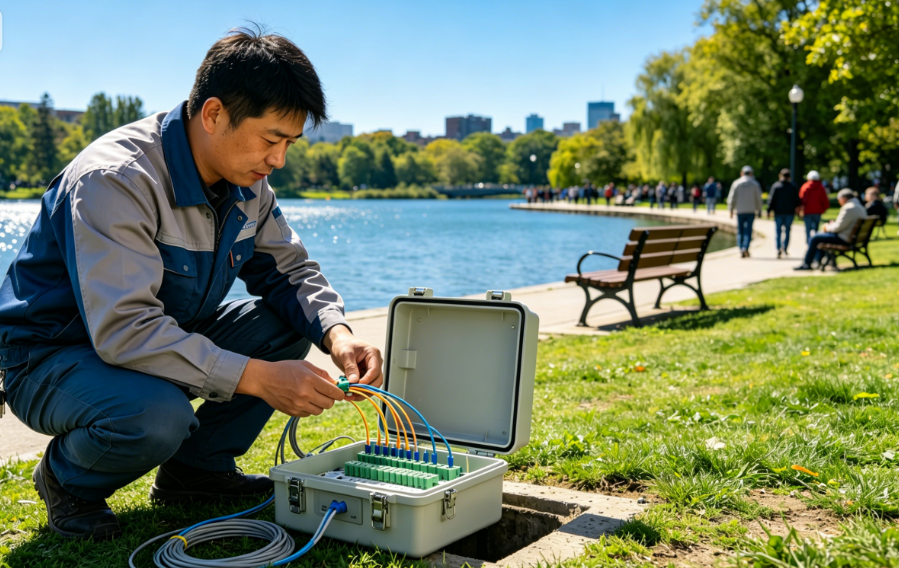
To ensure reliable performance, outdoor fiber cabling requires proper termination, splicing, and network design:
- Termination & Splicing: Outdoor fiber cables need weatherproof termination boxes and splice closures (IP67-rated, waterproof and dustproof) to protect connectors and splices from moisture and dust. We use fusion splicing technology to ensure low insertion loss (≤0.02dB per splice) and high signal integrity.
- Network Design: A star topology is ideal for campus and park networks—with a central distribution point (e.g., data center, network closet) connected to multiple access points (Wi-Fi hotspots, surveillance cameras, outdoor lighting) via fiber cables. This design allows for easy expansion—adding new access points simply requires running additional fiber from the central point. Our team can design a custom layout tailored to your space’s size, layout, and user needs.
6. Maintenance Tips for Long-Term Outdoor Fiber Reliability
Regular maintenance is key to ensuring your outdoor fiber cabling system operates reliably for years. Here are our top tips:
- Conduct regular inspections to check for cable damage, loose connectors, or water intrusion in termination boxes.
- Clean termination boxes and splice closures periodically to prevent dust and moisture buildup.
- Test cables annually for signal loss or continuity—catching issues early to avoid downtime.
We offer ongoing maintenance support, including cable testing, troubleshooting, and repair, to keep your outdoor network running smoothly.
Outdoor fiber cabling is the ideal solution for campus, park, and large-area network coverage—offering superior bandwidth, durability, and scalability. By selecting the right fiber type, cable protection, installation method, and network design, you can ensure reliable, high-speed network coverage for your outdoor space.
As your trusted structured cabling partner, we provide end-to-end outdoor fiber solutions—from design and supply to installation and maintenance. Contact us today to learn more about how we can support your outdoor network project.

