


- All
- Product Name
- Product Keyword
- Product Model
- Product Summary
- Product Description
- Multi Field Search
Views: 0 Author: Site Editor Publish Time: 2025-12-30 Origin: Site
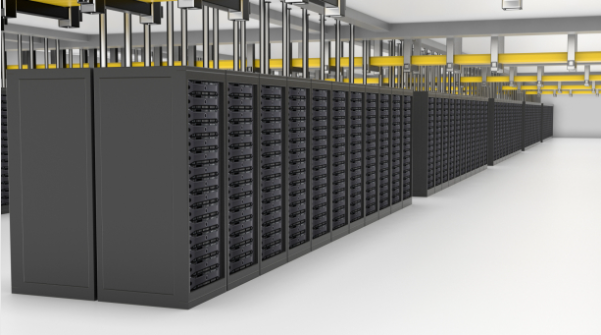
In a multi-tenant data center (MTDC), a scientifically designed and standardized cabling system is the foundation for supporting flexible business expansion, ensuring service quality and reducing total costs. Below, I will sort out for you the complete wiring method from the external optical cable access to the end customer's cage area in the order of data flow.
outdoor optical cable access
Outdoor optical cables are the "information arteries" of data centers. When choosing and applying them, key considerations should be given to the type, density and deployment method.
- Optical cable type selection: Single-mode optical cables are the mainstream choice. Make decisions based on the number of optical fiber cores: When the number of cores is less than 144, the traditional loose-tube type optical cable has a high cost performance. When the number of cores exceeds 144 or even 288, ribbon optical cables have more obvious advantages in deployment efficiency and commercial cost.
High-density solutions: To cope with the data deluge brought about by AI, cloud computing, etc., the industry has launched outdoor optical cable products with 6,912 cores or more, which reserves a huge space for future expansion.
- Key deployment plan:
- Microcatheter system: Highly suitable for the MTDC business model. It can be like an "apartment building", dividing independent micro-pipes for different tenants within the main conduit, achieving physical isolation, on-demand deployment, and flexible expansion, helping you and your customers realize "on-demand purchase".
- Pre-connected optical cables: Optical cables with factory-pre-termination MPO/MTP connectors can achieve "0 splicing" rapid deployment in the computer room, significantly reducing on-site operation time and fault risks.
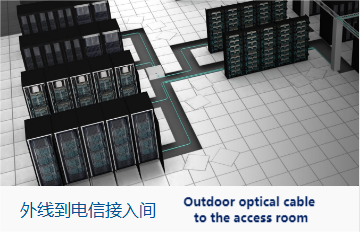
access room
The access room is the "front desk" for outdoor networks to enter the data center. Its core task is to complete the termination, transition and management of optical cables, with the top priority being to reduce risks.
- Core function: After terminating the outdoor optical cable, it is distributed to the main distribution area or other areas through cross-connection.
Optical cable termination: Hot fusion splicing is preferred. Compared with mechanical cold splicing, it can provide more stable and reliable connection quality and better avoid optical cable failures and signal attenuation. For high-core-count optical cables, the efficiency advantage of large-scale splicing is more obvious.
- Risk Control: Network outages may cause significant losses. It is crucial to choose a supplier that can provide comprehensive training, on-site support and reliable products. All termination operations must be standardized, and the optical cables should be cleaned and inspected.

The main distribution area is the "heart" of the structured cabling system in a data center, serving as the central distribution point and core cross-connection location of the entire network.
Simplify cabling and management: Investing in a structured cabling system is crucial. For instance, by adopting an optimized product solution, all cross-connections across two racks only require a single length of jumper, which can greatly simplify daily maintenance, movement, addition and modification.
Cleanliness is competitiveness: A tidy and organized wiring area not only guarantees efficient operation and maintenance but also serves as a "living advertisement" to showcase professional capabilities to potential customers, significantly enhancing customer trust.
Standardized architecture: Following the star topology recommended by standards such as TIA-942, the main distribution area is connected to one or more horizontal distribution areas through backbone cables and may directly connect to core routers, switches and other devices.

cage area wiring
The cage area is the "home" of tenants' equipment, and the wiring design needs to strike the best balance among density, flexibility and cost.
High density and maintainability: The adoption of high-density patch panels (such as 1U height modules supporting 144 cores) can maximize the utilization of expensive rack space. However, at the same time, it is necessary to ensure that the density design does not sacrifice the convenience of operation. For example, a modular drawer structure can be adopted to facilitate maintenance.
Future-oriented technologies:
Parallel optics and port branching: These are the key technological trends in cage cabling. For instance, through the port branching solution, one 40G port can replace four 10G ports, which can significantly reduce the number of chassis and line cards as well as power consumption (by approximately two-thirds), and lower the cost per port.
Pre-terminated system: It is also recommended to use a pre-terminated optical fiber distribution system within the cage area. It is plug-and-play and can significantly reduce the cabling time for customers' equipment to go online.
Fiber optic type consideration: Choose between single-mode and multi-mode fibers based on transmission distance and cost. Multimode fiber solutions (such as OM4) can meet applications ranging from 10G to 100G and even 400G, and support smooth upgrades to higher rates.
construction and acceptance
Excellent design requires standardized construction to be guaranteed.
Avoid co-voltage with copper cables and prohibit overly small bending radii.
Use nylon rope instead of plastic cable ties for binding to prevent damage to the optical cable.
For pre-terminated optical cables, tensile force should be applied to the protective sleeve, and the fragile MTP/MPO connectors should be carefully protected.
Optical fiber acceptance test:
Bidirectional end-to-end loss testing must be carried out.
It is crucial to clean all optical fiber connectors before testing.
- Use appropriate test jumpers and set up benchmarks.
frontier technologies and developments
Wiring technology is also constantly evolving and is worth your attention
Ultra-high density cabling: The industry is promoting technologies such as some bonded optical fiber tapes and low-diameter optical fibers, providing unprecedented core density in the same space (for example, a 39mm outer diameter cable tube can accommodate 6,912 optical fibers).
Edge computing and 5G-driven: Future trends such as edge data centers and 5G will prompt MTDC to impose higher requirements on cabling planning and flexibility.
summary
Cabling in a multi-tenant data center is an art of balancing planning, technology and risk. From the careful selection of outdoor optical cables, to the strict risk control of the termination process in the access room, to the centralized intelligent management of the main distribution area, and even to the combination of high density and flexibility in the cage area, every link needs to be considered comprehensively. Only by adhering to standards, selecting high-quality products and attaching importance to standardized construction can an efficient, reliable and future-oriented data vein be built.

