English


Views: 0 Author: Site Editor Publish Time: 2026-08-28 Origin: Site
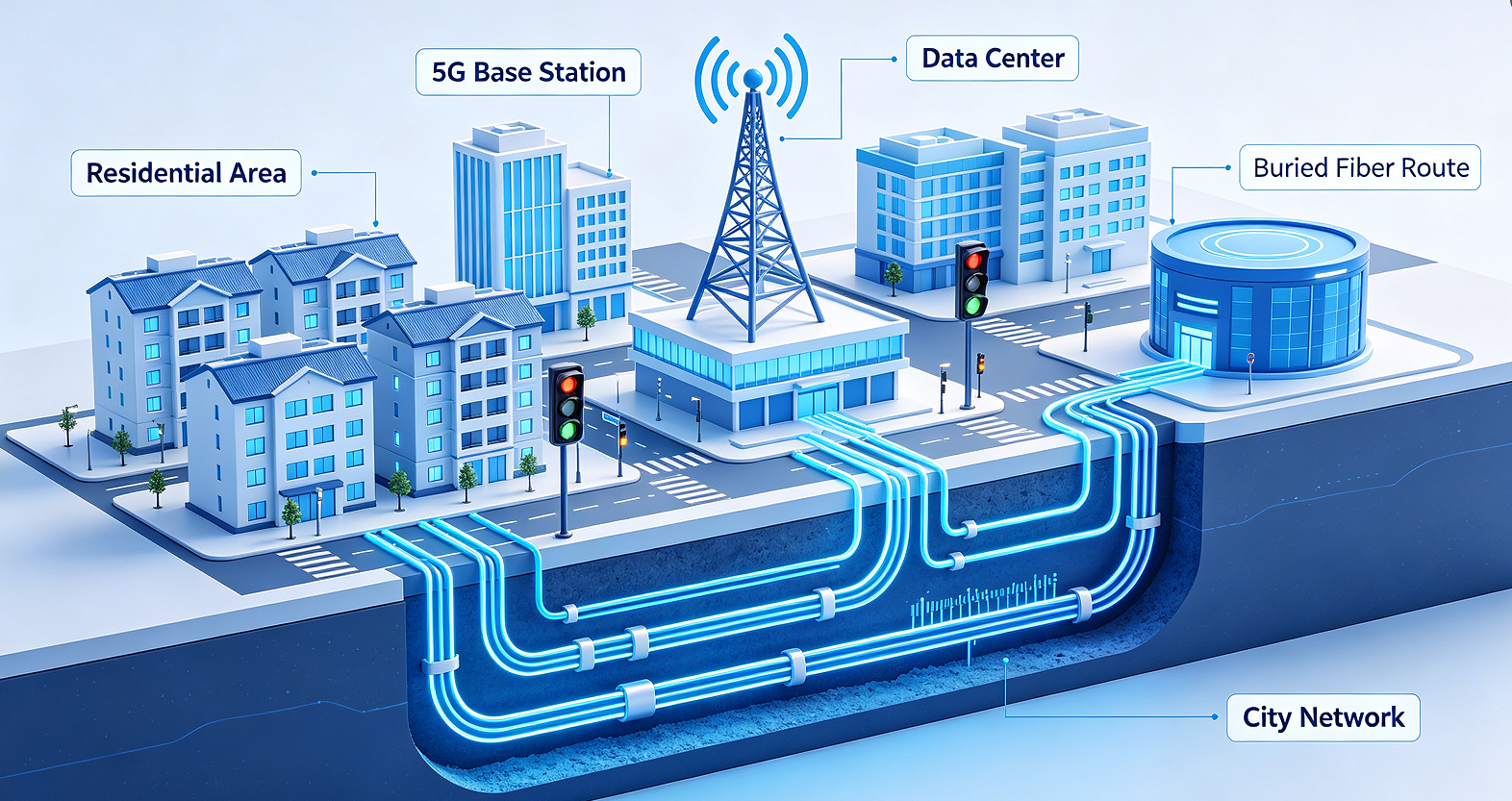
When we enjoy smooth 4K videos, interact with friends far away in real time, or make a stock transaction at the millisecond level, we may seldom think that what supports all of this are the "buried optical fibers" as thin as hair buried deep in the soil beneath our feet. They are like the "invisible arteries" of modern society, quietly carrying over 90% of the world's data traffic and forming the most solid physical foundation of the digital world.
Today, let's talk about this unsung hero behind the scenes - buried optical fibers.
In simple terms, underground optical cables are armored optical cables specially designed for underground environments. They can be directly buried in the soil or laid through pipes, and are resistant to moisture, compression, settlement, and insect and rodent gnawed damage.
Many engineering misunderstandings are: randomly burying ordinary overhead optical cables underground. Ordinary unarmored optical cables lack the ability to resist pressure, rodents and moisture. After being buried underground, they are prone to problems such as water seepage, increased attenuation, core breakage and peeling, and frequent malfunctions occur within one or two years.
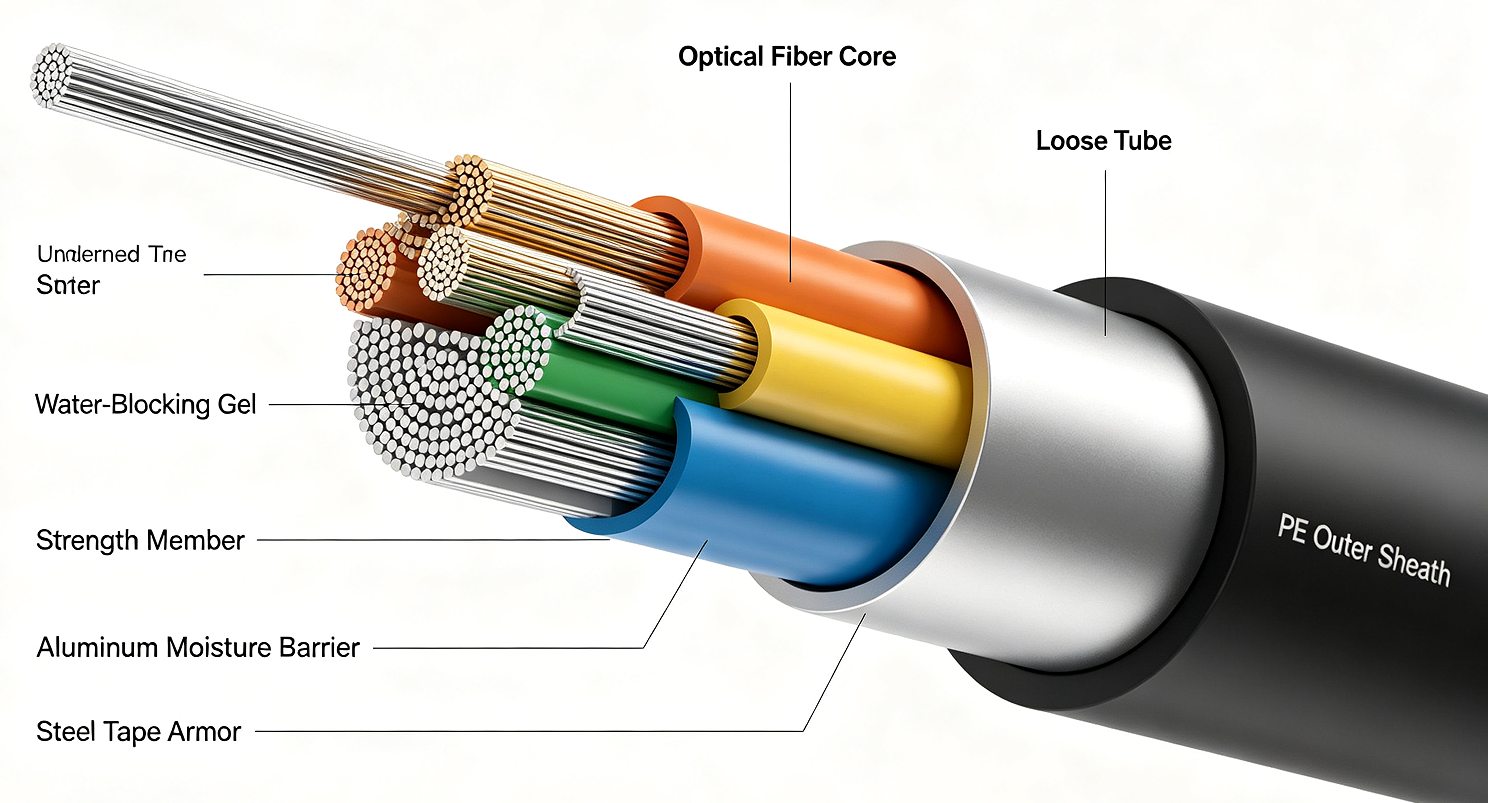
The standard underground optical cables (commonly GYTA53 and GYTS53) come with double-layer protection and steel tape armoring, making them truly "underground dedicated communication cables", suitable for the harsh working conditions of long-term burial.
Compared with the more common overhead optical cables set up on utility poles, buried optical fibers have significant advantages, but they also face unique challenges.
1. Overhead optical cables have extremely strong stability and a very low failure rate. They are vulnerable to strong winds, typhoons, heavy snow, scratches from trees, and impacts from foreign objects at heights. When the weather changes, they are prone to shaking, fiber breakage, and disconnection. Buried optical cables isolate the open-air environment, providing more stable transmission, less attenuation and lower latency. They are highly suitable for backbone links and important dedicated lines.
2. Excellent anti-interference capability: The optical fiber itself is not affected by electromagnetic interference. Coupled with underground enclosed protection, it is not afraid of the influence of high voltage electricity, frequency converters, and electromagnetic radiation from equipment. Data transmission is clean and stable, making it the first choice for industrial, government and enterprise, and computer room interconnection.
3. The city appearance is clean and tidy, in line with urban planning. The disorderly overhead cables not only affect the aesthetics but also hinder road renovation and pipeline upgrading. The underground burial method completely conceals pipelines, keeping the road surface clean and tidy. It is a standard feature for the construction of smart and civilized cities.
4. High safety and longer service life: Overhead lines are prone to being damaged by humans, stolen, or accidentally touched during construction. Buried optical cables are marked, protected and highly concealed, with a lower probability of being damaged by external forces. With proper construction, they can be stably used for 20 to 30 years.
1.High construction costs: The initial investment for buried optical fibers is huge. The cost of traditional underground laying can reach 500,000 to 800,000 yuan per kilometer, with a construction period of 6 to 12 months. The overall cost is usually more than twice that of the overhead method.
2.Complex construction and maintenance: Construction requires road excavation, involving complex pipeline coordination and geological assessment. Once a fault occurs, the difficulty of locating and repairing it is much higher than that of overhead optical cables. Common causes of malfunction include accidental digging during construction, water ingress into the joint box, and damage from animals, etc.
The reason why underground optical cables are durable lies in their multiple layers of protection and safety nets, each with a clear function:
1. Optical fiber core + loose tube communication transmission core, combined with environmentally friendly water-blocking paste, waterproofing, buffering and protecting the fiber core from the source, avoiding signal attenuation caused by slight bending.
2. The central reinforcing core is supported by high-strength steel wire to prevent fiber breakage caused by laying pulling and soil settlement stretching, ensuring the tensile performance of the optical cable.
3. The moisture-proof layer of the aluminum strip forms a closed moisture-proof barrier, blocking the infiltration of groundwater and soil moisture, and preventing the deterioration of the link caused by long-term moisture.
4. The steel tape armoring layer (core protection) is the most crucial layer for underground optical cables. It is resistant to pressure, crushing, rodents, and termites, preventing the sheath from being crushed by crushed stones or gnawed through by insects and rodents.
5. The thickened PE outer sheath is wear-resistant, corrosion-resistant and aging-resistant, suitable for various soil acid and alkali environments, and can resist long-term underground erosion.
In addition to data transmission, underground optical fibers are also being endowed with a brand-new "superpower" - distributed optical fiber sensing - due to their unique physical properties.
The principle of this technology is that when light is transmitted through optical fibers, external vibrations, stresses or temperature changes will subtly alter the characteristics of the light. By analyzing these changes, the entire underground optical cable has transformed into a distributed sensor that is tens or even hundreds of kilometers long.
Earthquake monitoring: Researchers can utilize existing buried optical fibers (dark optical fibers) to capture seismic waves and achieve early earthquake warnings.
Urban safety: It can monitor in real time whether there are mechanical vibrations from illegal construction around pipelines. Once an excavator approaches, the system can immediately locate it and sound an alarm to prevent optical cables from being dug up and broken.
The "personal doctor" of urban pipe networks: In underground utility tunnels, temperature-sensing optical fibers can continuously monitor temperature changes 7×24 hours a day with an accuracy of ±0.1℃, accurately locating leakage points or fire hazards, and allowing tens of kilometers of pipe networks to bid farewell to "numbness and dullness".
The "X-ray eye" for water conservancy monitoring: Without the need to dig Wells, simply bury optical fibers directly into the soil to achieve long-distance and automated monitoring of soil moisture content and groundwater levels, providing a scientific basis for agricultural irrigation and flood control and drought relief.
Energy and geological exploration: The permanent deployment of optical fibers in gas storage facilities or geothermal Wells can monitor the temperature and pressure changes underground in real time, providing a "permanent neural network" for energy extraction.
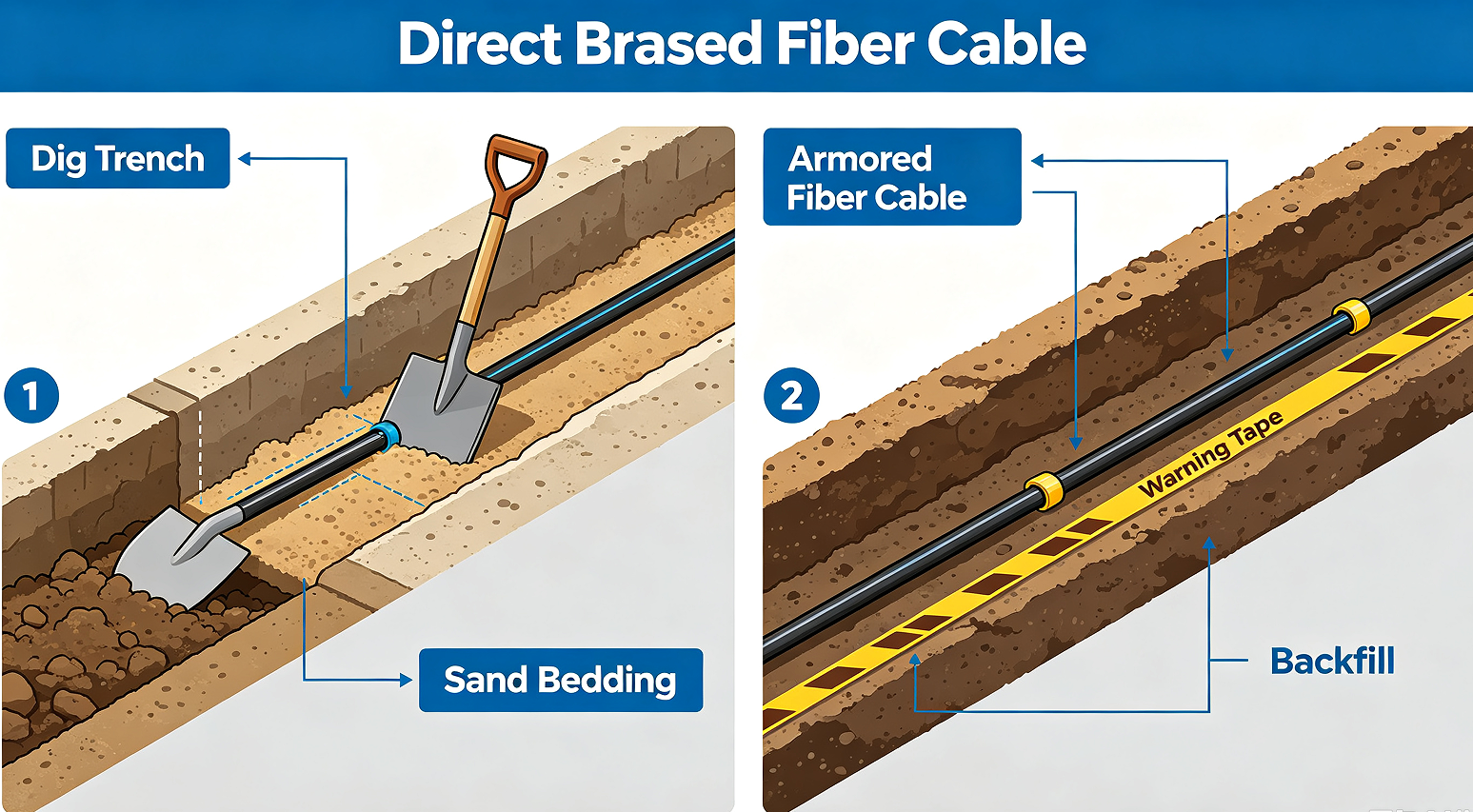
Underground burial is not simply "digging a pit and burying it". The industry mainly consists of two techniques: direct burial and pipeline laying, with very clear division of labor in different scenarios.
Dig the trench directly, lay the armored optical cable in the trench, spread fine soil, cover it with warning tape, and then backfill and compact it. The advantages are low cost, fast construction, no need for pre-buried pipes, and it is suitable for long-distance field trunk lines, rural networking, and remote sections.
Key requirements: The bottom of the trench should be flat without hard lumps or crushed stones. If necessary, a fine soil cushion layer should be laid. The burial depth should be strictly controlled to prevent the optical cable from being crushed by agricultural machinery or ground subsidence.
First, pre-bury PVC/PE communication pipes, and then carry out cable threading construction later. Although the initial cost is higher, it has significant advantages: optical cables are not directly under pressure, maintenance is convenient, cable expansion can be repeatedly carried out, and there is no need to dig new trenches for road surface renovation in the later stage. It is the mainstream solution for densely populated urban areas.
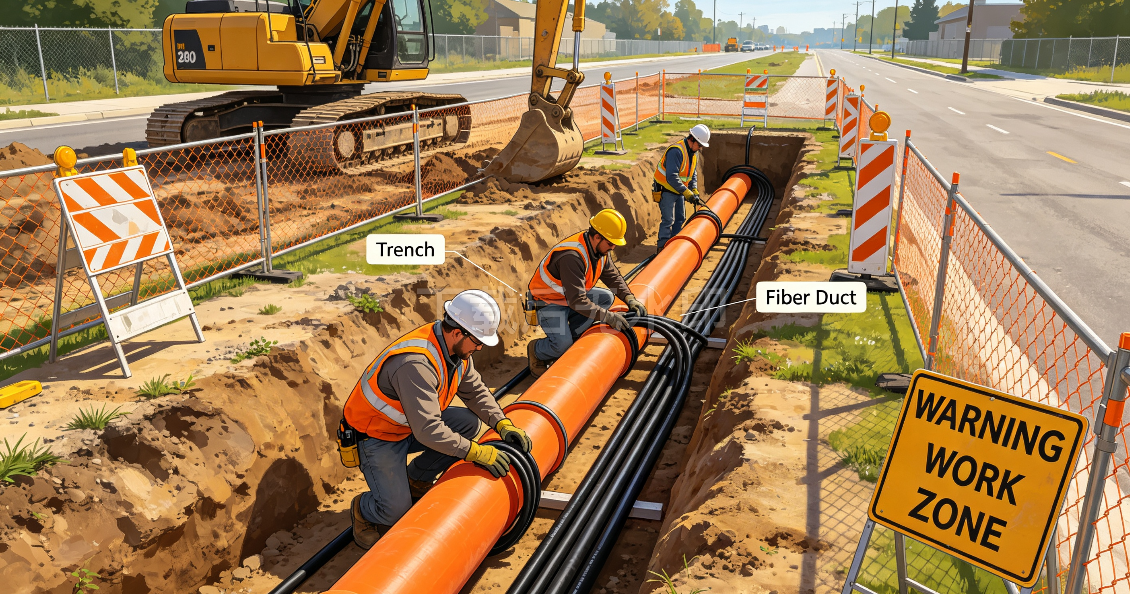
The birth of an underground optical cable is a systematic project that integrates precise planning and rigorous construction.
1. Precise planning: Engineers will utilize GIS geographic information systems and ground radar to construct three-dimensional underground space models and plan the optimal and safest routes.
2. Scenario-based construction
l Urban roads: Micro-trench technology is adopted, with a trench width of only 1-2 centimeters, causing minimal damage to the road surface and enabling rapid resumption of traffic.
l Suburban farmland: Using vibrating plows to directly dig trenches and bury, the efficiency is extremely high, with a daily construction volume of up to 1,000 to 2,000 meters.
l Crossing obstacles: When encountering rivers or railways, horizontal directional drilling technology is adopted to precisely cross underground without damaging the surface.
3. Strict laying: During construction, the bending radius and traction tension of the optical cable must be strictly controlled to prevent damage to the fiber core. In the northern permafrost areas, special protection measures such as insulating sand are also required.
4. Precision splicing: The splicing of optical cables is a precise task. Engineers will use fully automatic splicers to perfectly connect two optical fibers as thin as hair under high-voltage electric arcs. The splicing loss can be controlled below 0.03dB, ensuring lossless signal transmission.
Buried optical cables are almost maintenance-free, but not zero-maintenance. On a daily basis, only two things need to be done: regularly inspect whether the route signs are intact, and prohibit deep soil excavation and illegal construction within the optical cable route range.
Common faults are basically concentrated in three categories: damage caused by third-party excavation, long-term compression and wear due to non-standard construction backfilling, and deterioration of the link caused by water accumulation and moisture. As long as the construction standards are met in the early stage, the markings are complete and the routes are clear, the failure rate can be reduced to an extremely low level.
Buried optical fibers, this "invisible artery" deeply buried underground, are no less important than the roads and Bridges we can see. With silence and tenacity, it has carried almost all the digital dreams of our era. The next time you browse the web smoothly, imagine that just a few meters beneath your feet, countless light pulses are speeding at speeds close to the speed of light, connecting the entire world.

