


- All
- Product Name
- Product Keyword
- Product Model
- Product Summary
- Product Description
- Multi Field Search
Views: 0 Author: Site Editor Publish Time: 2026-09-01 Origin: Site
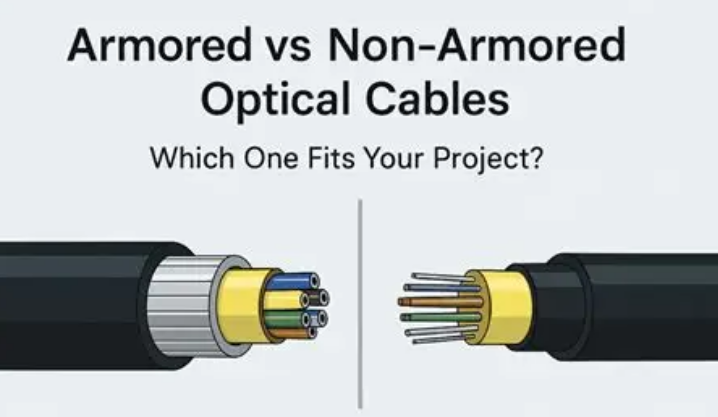
In the construction of communication optical cable projects, many people are troubled by a core issue: Are ordinary standard optical cables sufficient? In what scenarios must armored optical cables be used?
The core difference between two types of optical cables that seem similar in appearance does not lie in transmission performance, but in protection level, environmental tolerance and service life. The vast majority of problems such as core breakage, signal attenuation and rework during construction in optical cables are essentially caused by the mismatch between the protection level and the usage scenario.
Today, we will comprehensively disassemble the differences between armored optical cables and standard optical cables from five dimensions: structural principle, IP protection level, mechanical protection, environmental adaptation, and scenario selection, to help everyone make precise selections and avoid engineering risks.
The transmission core of all optical cables is the fiber core, coating layer and bundle tube. The performance dividing line between the two is entirely due to the design differences of the outer protective structure.
Standard optical cables are the basic type for civilian and regular communication scenarios. They have an extremely simple structure, from the inside out: fiber core → tube → filling paste → outer sheath (PVC/LSZH/PE), without any metal or high-strength reinforcing protective layer.
Its design core lies in lightweight, high flexibility and low cost. It is only suitable for flat, safe and non-external interferation-free laying environments. It can only resist the influence of basic environments such as slight dust and normal temperature dry air. Its compressive resistance, impact resistance and damage resistance are all at the lowest standard. Common regular models such as GYXTW all belong to unarmored standard optical cables. Their national standard compressive strength parameters are extremely low, and they can only withstand slight external force compression.
Armored optical cables are based on the complete structure of standard optical cables and add an extra layer of high-strength protective armor, which is equivalent to putting on a layer of "protective armor" for the optical cable and is also the core reason for its high protection level.
The mainstream armoring is divided into two categories to meet different protection requirements:
• Metal armoring: Steel tape armoring, aluminum tape armoring, and steel wire armoring offer the highest protective strength and possess extremely strong resistance to pressure, impact, and rodent bites. Among them, steel tape focuses on resisting compression, aluminum tape takes into account moisture-proof protection, and steel wire armoring is suitable for scenarios with extremely high tensile force.
• Non-metallic armor: FRP glass fiber armor, free of metal materials, corrosion-resistant, no electromagnetic interference, medium protective strength, lighter weight, suitable for special weak current and anti-corrosion scenarios.
At the same time, armored optical cables are divided into indoor single/double armor and outdoor light/heavy armor. The heavy armor is combined with a double-layer sheath structure, achieving an all-round upgrade in protection performance and being adaptable to extremely complex construction environments.
We combined the national standard parameters of the industry with the international common IP protection standards and mechanical force parameters to visually compare the protection capability differences between the two types of optical cables. All the data are the common standard values for engineering.
Optical cable type | Dust-proof grade | water-proof grade | Description of protective capability |
Standard optical cable | IP54 | IP53 | It can prevent daily dust and slight water dripping, but cannot withstand immersion or high-humidity water accumulation environments. Long-term dampness is prone to water seepage and oxidation |
Armored optical cable (rearmored | IP66 | IP68 | It is completely dust-proof and can be immersed in a water pressure environment of 0.1MPa for a long time. It can be stably used in underground direct burial, damp foundation pits and open-air scenarios |
From the protection level, it can be seen that standard optical cables are only suitable for indoor dry, well-ventilated and dust-free environments, while armored optical cables can be adapted to outdoor, underground, damp and other harsh and complex environments.
Performance indicators | Standard optical cable | Armored optical cable | Gap impact |
Maximum compressive load | ≤500N | ≥1000N | Standard optical cables are prone to deformation and core breakage under pressure, while armor can withstand construction rolling and soil layer compression |
Maximum tensile strength | Conventional: 300-500N | 800-2000N (Depending on the type of armor) | For long-distance overhead and pipeline traction construction, the armor is not easily torn or stretched and deformed |
Resistant to rat bites/biological damage | Without protection, it is extremely easy to be gnawed through | The metal armor is completely resistant to rodent bites | In scenarios with a high incidence of rodent damage such as the wild, basements, and pipe galleries, standard optical cables are extremely prone to being scrapped |
Impact resistance capacity | Weak, even minor impacts can easily damage the core | It is strong and can withstand construction bumps and the impact of crushed stones | In outdoor construction and earthwork backfilling scenarios, the failure rate of armor has been significantly reduced |
Standard optical cables do not have a rigid protective layer. Once they are buried by soil layers, crushed by the ground or squeezed by pipes, the sheath is very likely to collapse, directly breaking the internal fiber core and causing communication interruption. This is also the core reason why many simple underground optical cables are scrapped in the short term.
The steel tape and metal layer of armored optical cables have a rigid support structure, which can evenly distribute external pressure. Even if they are directly buried underground or the soil is backfilled and compacted, they can completely protect the internal fiber core from being squeezed and damaged. It is an essential choice for underground direct burial projects.
In scenarios such as basements, pipe galleries, outdoor green belts, and machine room trenches, rodent infestations are the biggest hidden killers of optical cables. The outer sheath of standard optical cables is soft, allowing rats to easily gnaw through the sheath and break the fiber core, causing large-scale network paralysis.
The hard metal layer of the metal armored optical cable can completely prevent rodents from gnawing on it. Even if the outer sheath is worn out, the internal transmission structure remains intact, making it perfectly suitable for various areas with a high incidence of rodent damage. Non-metallic armor can also achieve a moderate level of anti-gnawing effect, making it suitable for scenarios with mild rodent damage.
The waterproofing of standard optical cables relies solely on the outer sheath, which has limited sealing performance. If they are exposed to damp, waterlogged, or acidic or alkaline soil environments for a long time, water vapor will slowly penetrate, leading to increased core attenuation, insulation failure, and a shortened service life.
Armored optical cables mostly adopt a double-layer sheath + armored sealing structure. Some models are equipped with an aluminum strip moisture-proof layer, maximizing their waterproof and moisture-proof performance. At the same time, the dedicated heavy-duty armored optical cable can resist outdoor ultraviolet aging and corrosion from acidic and alkaline soil. Its outdoor service life can reach over 20 years, far exceeding the standard optical cable's service life of about 10 years.
Standard optical cables have no shielding structure. In scenarios with a high concentration of strong electricity and electromagnetic equipment, they are prone to electromagnetic interference, which slightly affects the transmission stability. Metal armored optical cables come with a metal shielding layer, which can effectively block external electromagnetic interference and ensure the stability of high-speed optical signal transmission. They are suitable for complex electromagnetic environments such as computer rooms, power pipelines, and industrial plants.
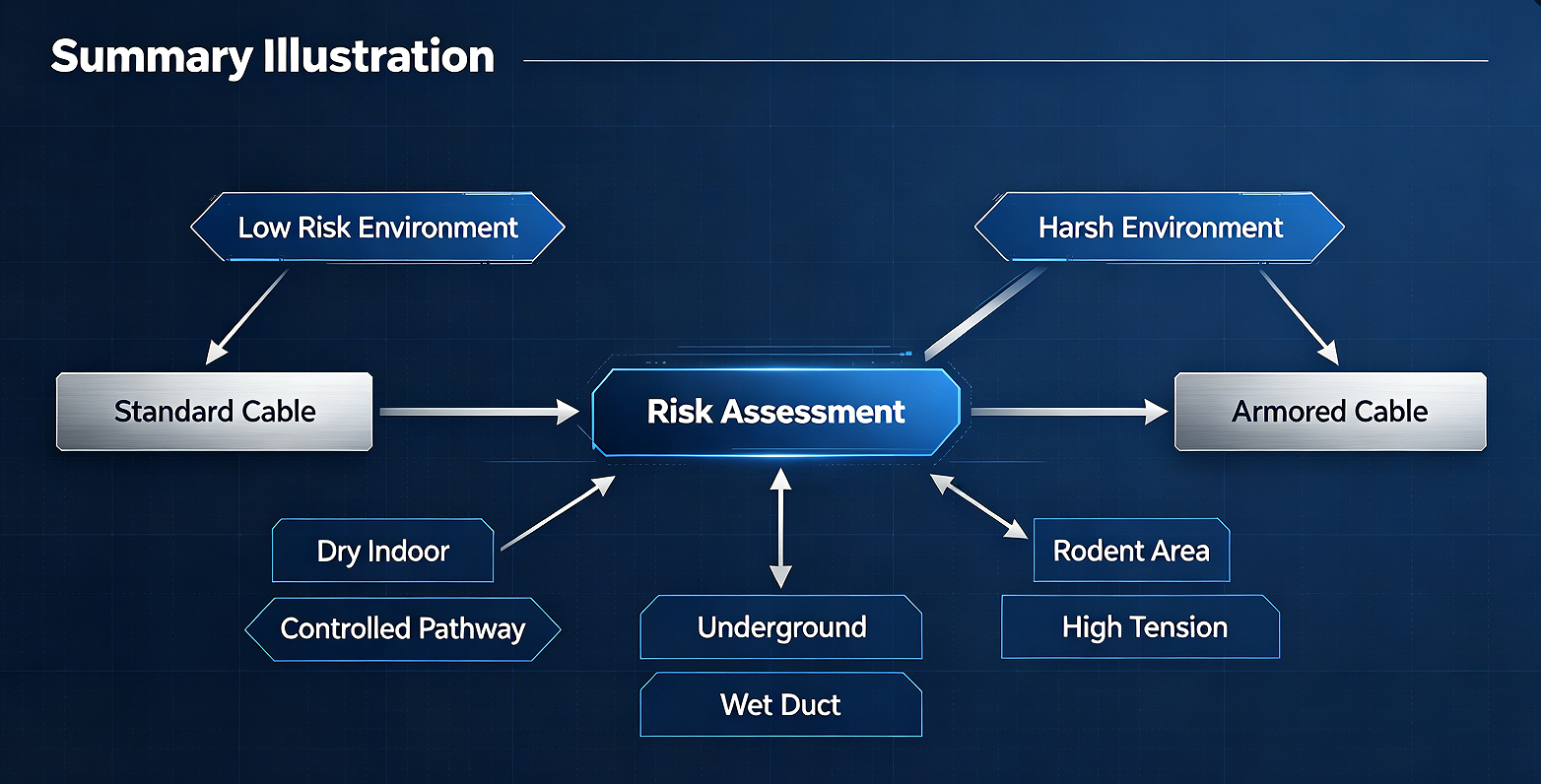
In many projects, excessive selection leads to cost waste, or insufficient selection causes rework and malfunctions. Precise matching of scenarios is the best solution.
✅ scenarios where standard optical cables are preferred
• Indoor computer room wiring, vertical weak current cable trays in buildings, and installation within ceilings
• A closed indoor environment that is dry, dust-free, free from external pressure and rodent damage
• Short-distance and lightweight wiring for conventional civilian scenarios that pursue convenient construction and cost control
Advantages: Good flexibility, easy to bend, high construction efficiency, high cost performance, fully meeting the conventional transmission requirements.
✅ scenarios where armored optical cables must be selected
• Outdoor direct burial, deep pipeline burial, and earthwork laying scenarios in green belts
• Basements, pipe galleries, trenches, and enclosed Spaces with damp water accumulation
• Areas with a high incidence of rodent damage such as the wild, factory zones, and old residential areas
• Strong electromagnetic interference environments such as industrial plants and power corridors
• Construction scenarios involving long-distance overhead, complex terrain, and prone to bumps and crushing
Core value: With a slight increase in cost, avoid the high costs of disconnection, emergency repair and rework in the later stage, and ensure the long-term stability of communication.
Many construction workers directly bury standard optical cables such as GYXTW underground. These optical cables have no armor protection and have extremely poor pressure resistance, water resistance and rodent resistance. It is highly likely that core breakage faults will occur within half a year, which is a typical case of illegal construction. For underground scenarios, armor models such as GYTA53 and GYTZA53 must be selected.
In indoor scenarios such as computer room trenches, underground computer rooms, and old indoor pipe galleries where there is a risk of rodent damage and compression, indoor armored optical cables must be used to avoid the situation where faults in concealed works cannot be detected later.
Light armor is suitable for conventional outdoor overhead, heavy armor with double-layer sheath is suitable for direct burial and deep burial, and non-metallic armor is suitable for anti-corrosion and non-electromagnetic scenarios. Only by selecting the type as needed can performance and cost be balanced.
Standard optical cables and armored optical cables have no difference in transmission performance, but their protection levels are worlds apart.
Standard optical cables = basic transmission, lightweight, low cost, only suitable for safe and dry indoor scenarios;
Armored optical cables = all-round protection, anti-crushing, anti-rodent biting, moisture-proof and anti-corrosion, suitable for all scenarios, especially harsh environments.
The core logic of project selection: Standard equipment should be used indoors without risk, while armored equipment must be used outdoors, in concealed and harsh environments. It is better to invest reasonably in protection costs in the early stage than to pay several times the price for fault repair and rework rectification in the later stage.

