


- All
- Product Name
- Product Keyword
- Product Model
- Product Summary
- Product Description
- Multi Field Search
Views: 0 Author: Site Editor Publish Time: 2026-08-21 Origin: Site
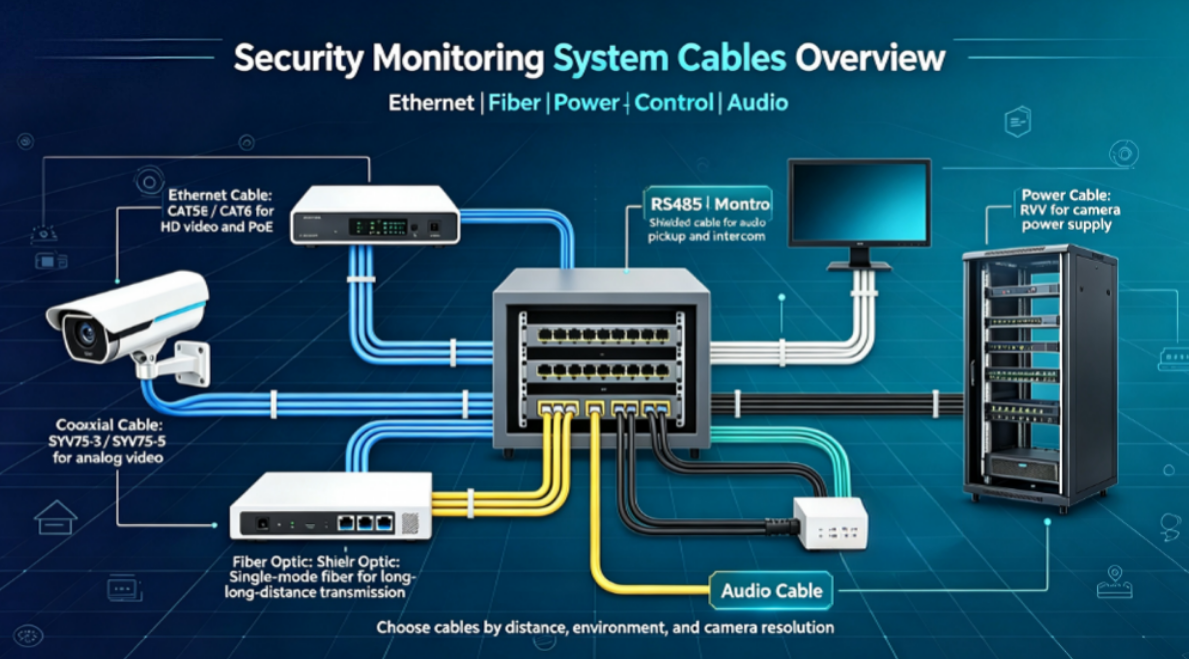
In the entire security monitoring system, the stable operation of devices such as cameras, video recorders, switches, and displays cannot do without standardized wiring construction at its core. Many surveillance failures, such as picture stuttering, no image, device offline, and night vision failure, are over 80% caused by incorrect cable selection, substandard cable quality, or non-standard wiring methods.
For practitioners in weak current engineering, project operation and maintenance personnel, as well as the person in charge of security renovation in enterprises, residential areas and factories, clarifying the functions, applicable scenarios and selection points of various cables in the monitoring system is the foundation for doing a good job in monitoring projects. Today, we will comprehensively disassemble all the core cables involved in the wiring of security monitoring systems for you. We will explain them one by one from transmission, power supply, auxiliary signals to matching wires. It's full of valuable information. It is recommended to save it for future use.
Video transmission cables are the "neural network" of the monitoring system, mainly responsible for transmitting the video images, audio signals, and PTZ control signals collected by cameras to the back-end devices. They are the most core category of wiring and are mainly divided into two categories: network monitoring cables and analog monitoring cables.
At present, over 90% of high-definition network surveillance (IPC cameras) on the market use network cables for transmission, which are also the preferred cables for modern security projects.
Core application: Transmits high-definition video, audio, and 485 control signals from pan-tilt units. It also supports POE power supply, solving "power supply + signal transmission" with one cable, significantly simplifying wiring.
Wire differences and selection
• CAT5e network cable: Supports 100M transmission, compatible with 1080P, 2-megapixel and below cameras, transmission distance ≤100 meters, high cost performance, suitable for common scenarios such as residential areas, shops, and ordinary factory areas.
•Category 6 network cable (CAT6) : It supports gigabit high-speed transmission, offers greater bandwidth and stronger anti-interference performance. It is compatible with 4-megapixel, 8-megapixel, and 12-megapixel high-definition cameras, and supports concurrent transmission of multiple video channels. It is suitable for high-end scenarios such as large factories, office buildings, parks, and high-definition large-screen monitoring.
Construction tips: Outdoor wiring must use outdoor waterproof and oxygen-blocking network cables to avoid exposure to sunlight, rain, oxidation and aging. Long-distance wiring should avoid strong current lines as much as possible to reduce signal interference.
Coaxial video cables are dedicated materials for old-fashioned analog surveillance and AHD coaxial high-definition surveillance. Currently, they are still widely used in the renovation projects of old residential areas and old factories, but have been largely replaced by network cables in new construction projects.
Core application: It can independently transmit analog video images without network signals and is used in conjunction with analog cameras and DVR recorders.
Model difference
•SYV75-3: Transmission distance ≤200 meters, suitable for indoor short-distance monitoring points.
•SYV75-5: Thicker core wire, better shielding performance, transmission distance ≤500 meters, suitable for long-distance outdoor locations.
Advantages: Strong anti-interference ability, stable picture transmission, and less distortion during long-distance transmission. Disadvantages: Only for video transmission, a separate power cord needs to be laid, and the wiring is cumbersome.
For scenarios such as large-scale parks, factories, campuses, and industrial parks where monitoring points are scattered and have large spans, the shortcoming of network cables with a transmission distance of less than 100 meters cannot meet the requirements. At this time, optical fibers must be used as the main transmission cables.
Core application: To achieve ultra-long-distance video signal transmission over kilometers, connect the switches in various areas with the central computer room, and serve as the backbone line of the monitoring system.
Key points for selection: In security monitoring projects, single-mode optical fibers should be given priority. The transmission distance can reach over 20 kilometers, with extremely low loss and maximum anti-electromagnetic interference capability. Multimode optical fibers are only suitable for short-distance indoor networking and are rarely used for monitoring backbone cabling.
Supporting equipment: Wiring should be used in conjunction with optical transceivers, optical modules, pigtails, and patch cords to achieve the conversion of optical and electrical signals.

In addition to POE network cables that can directly supply power, non-poe cameras, outdoor dome cameras, fill lights, switches and other devices all require separate power supply cables to ensure the stable operation of the equipment for 24 hours.
RVV flexible sheathed cable is a dedicated power supply cable for surveillance, providing power to low-voltage DC equipment. It is the most commonly used auxiliary cable in surveillance wiring.
Core application: Provide low-voltage power supply for 12V cameras, 24V dome cameras, infrared fill lights, waterproof boxes and other devices.
Selection criteria for wire diameter
•2*0.5 square: Indoor short-distance location, powered by conventional bullet cameras;
•2*0.75 square: Outdoor point, power supply for medium and long distances over 50 meters, with smaller voltage drop;
•2*1.0 square: High-speed dome camera, multi-channel centralized power supply, and long-distance wiring over 100 meters to prevent equipment restart and night vision faults caused by insufficient voltage.
It is mainly used for the 220V strong current connection of computer room equipment, centralized power supply boxes, switches, video recorders and monitors. Generally, 1.5/2.5 square BV single-strand hard wires are selected, with standardized wiring and high safety factor.
For intelligent monitoring devices with pan-tilt rotation, zooming and voice intercom functions, separate control and audio cables need to be laid out to achieve full coverage of device functions.
Core application: Mainly used for the control of analog PTZ cameras and low-speed pan-tilt cameras, achieving functions such as remote rotation, zooming, and preset position invocation. Most network dome cameras have integrated control signals through network cables and basically do not require separate wiring.
Key points: Shielded twisted-pair cables must be selected to effectively resist external interference and prevent problems such as the pan-tilt losing control, rotating randomly, and having no response.
Core application: It can be used in conjunction with surveillance microphones and speakers to achieve on-site sound collection and two-way voice intercom functions. It is widely applied in scenarios such as shops, elevators, security guards, and checkpoint monitoring. The shielding design can effectively eliminate current noise and ensure clear sound quality.
A complete set of surveillance wiring, in addition to the main cables, also requires various auxiliary wires to ensure standardized construction, stable equipment, and convenient later operation and maintenance
• Optical fiber patch cords/pigtails: Connection of optical fiber equipment in the computer room, connection of transceivers and switches;
•BNC connector: A dedicated connector for coaxial video cables, used to simulate the connection between cameras and video recorders.
• Crystal head/network panel: Formed by terminating network cables, compatible with switch and camera interfaces;
• Waterproof connectors and insulating sleeves: Waterproof, moisture-proof and anti-aging for outdoor wiring, extending the service life of wires.


1. Scene priority: For regular indoor scenarios, use Category 5e network cables and RVV power cords. For high count bits and multiple concurrent channels, choose Category 6 network cables. For long-distance cross-regional transmission, use optical fibers.
2. Environmental adaptation: For outdoor use, waterproof, sun-proof and oxygen-blocking wires must be used. Ordinary indoor wires must not be used outdoors to avoid short-term aging and damage.
3. Wire diameter matching: For long-distance power supply, the wire diameter of the power line must be increased to prevent voltage drop from causing abnormal operation of the equipment.
4. Separation of strong and weak electricity: Video and control weak current cables should be laid separately from 220V strong current cables, with a spacing of no less than 30cm to avoid signal interference.
The cables of the security monitoring system may seem complex, but in fact, they have clear divisions of labor: network cables are responsible for high-definition network transmission, coaxial cables are responsible for old-fashioned analog monitoring, optical fibers are responsible for long-distance backbone networking, RVV lines are responsible for equipment power supply, and shielded wires are responsible for control and audio signals.
Reasonable cable selection and standardized wiring construction are the foundation for the long-term stable operation of the monitoring system. Many projects seem to have high-end equipment configurations, but due to poor-quality wires and incorrect selection, they frequently malfunction, significantly increasing operation and maintenance costs. Mastering the above cable knowledge can make work twice as effective with half the effort, whether it is for new project construction, renovation of old systems, or troubleshooting.


