


- All
- Product Name
- Product Keyword
- Product Model
- Product Summary
- Product Description
- Multi Field Search
Views: 0 Author: Site Editor Publish Time: 2026-10-16 Origin: Site
Fiber network operators and ISPs always face a choice when deploying aerial fiber: over-engineered heavy trunk cables or lightweight cost-saving distribution cables. ASU cable, widely known as Mini ADSS, has become a dominant solution for urban and suburban FTTH aerial distribution across emerging markets.
ASU stands for Aerial Self-Supported Unit, a compact all-dielectric self-supporting optical fiber cable. It shares the core “all dielectric, self-supporting” concept with classic ADSS, but is redesigned for short-span pole-to-pole FTTH distribution, not long-haul power line communication. Many engineers refer to it as Mini ADSS because it is essentially a downsized, simplified version of standard ADSS cable.
ASU / Mini ADSS is an outdoor aerial fiber optic cable with fully non-metallic construction. It requires no separate messenger wire for overhead installation.
· Structure: Central loose tube design. Optical fibers sit inside a single PBT loose tube filled with water-blocking gel for moisture protection.
· Strength members: Two parallel FRP (Fiber Reinforced Plastic) rods, SZ stranded alongside the central tube to provide tensile strength. No aramid yarn in the main reinforcement.
· Fiber count: Typically ranges from 2 cores up to maximum 24 cores, using single-mode fibers like G.652D or G.657A2.
· Outer sheath: HDPE jacket; anti-tracking AT jacket is usually optional, not mandatory for most FTTH deployments.
· Span rating: Standard design for 80 m – 120 m pole spans; some variants support up to 150 m maximum span.
1. All dielectric: Zero metal components, immune to electromagnetic interference, safe for installation near low-voltage power lines.
2. Lightweight & small diameter: Much lighter than standard ADSS, imposes far less wind load and static load on utility poles. In most cases, pole reinforcement is unnecessary.
3. Fast, simple installation: Field technicians can string ASU manually without heavy tensioning equipment. Stripping and splicing are easier.
4. Cost efficient: Lower material and transportation cost compared with standard ADSS, perfectly matched for FTTH distribution segments.
5. Dual deployment: Suitable for aerial installation, and can also be routed in ducts for short underground runs.
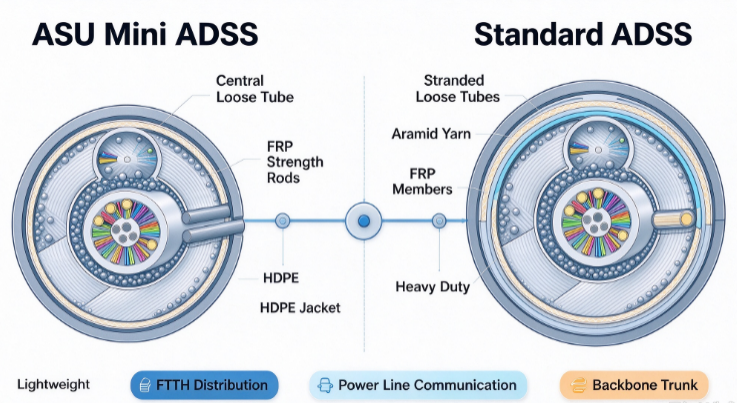
Both are all-dielectric self-supporting aerial fiber cables, so they are often confused. But they are engineered for completely different network layers.
Item | ASU / Mini ADSS | Standard ADSS |
Structure Type | Central single loose tube + dual FRP strength rods | Stranded multi loose tube + aramid yarn (Kevlar) reinforcement |
Fiber Capacity | 2–24 fibers max | 2–288 fibers, high fiber counts available |
Design Span | Short span: 80–120 m | Long span: 200 m up to 1000 m+ |
Strength Member | FRP rods | Aramid yarn (primary), FRP optional |
Jacket Option | Normal HDPE for FTTH; AT sheath optional | Anti-tracking (AT) HDPE sheath mandatory for high-voltage power line routes |
Weight & OD | Small diameter, lightweight, low pole load | Larger diameter, heavier, higher wind load |
Installation | Manual stringing, simple hardware | Requires professional tension calculation, heavy installation tools |
Primary Application | FTTH last-mile / distribution, urban & suburban pole aerial | Power transmission line communication, telecom backbone, long-span overhead trunk |
Engineering Requirement | Simple mechanical calculation | Strict EDS, MAT, creep, corona and electric tracking simulation |
Standard ADSS adopts a stranded loose-tube design. Multiple loose tubes are wrapped around a central core, and high-strength aramid yarn layers bear the tensile load. This multi-layer structure supports high fiber counts and extreme tension over long spans.
ASU simplifies this architecture down to one central loose tube paired with two FRP rods. The simpler structure cuts weight and size, but cannot handle high tension or large fiber quantities.
Standard ADSS was originally designed for deployment along high-voltage power transmission lines. It must resist electric tracking, corona discharge, strong wind, ice load and long-term creep. It is a trunk/backbone cable.
ASU (Mini ADSS) targets FTTH distribution networks. It connects cabinet to pole or pole to building in residential zones. It is overkill to deploy full-size standard ADSS for these short 80–120 m spans, which brings extra material cost and pole loading risks.
Standard ADSS needs comprehensive power industry engineering analysis: EDS (Everyday Stress), MAT (Maximum Allowable Tension), wind/ice load and aging under high electric field. Anti-tracking sheath is critical to avoid surface carbonization near HV lines.
ASU works under low electric field environments. Its HDPE jacket is regular outdoor grade, and anti-tracking property is not required for most FTTH scenarios. Its mechanical specification is optimized for short span static tension only.
ü FTTH distribution aerial links between street cabinets and customer premises
ü Urban / suburban areas with pole spacing 80–120 m
ü Projects where utility poles have limited load capacity
ü ISP projects looking to reduce capex and speed up field rollout
ü Low voltage corridors, not high voltage power transmission corridors
ü Long-span overhead routes over rivers, valleys, mountains
ü Fiber trunk lines installed alongside high-voltage power lines
ü Networks requiring high fiber counts (48F, 96F, 144F, 288F)
ü Sites with heavy ice, strong wind and extreme environmental loads
ASU (Mini ADSS) is not a replacement for standard ADSS. It is a purpose-built compact alternative for the FTTH last-mile distribution layer.
Standard ADSS is the heavy-duty backbone solution built for long spans and high-voltage environments. ASU inherits the all-dielectric self-supporting concept, then reduces fiber capacity, mechanical rating and cable weight to deliver a lean, fast-to-install, cost-effective aerial cable for access networks.
For telecom project planners, the key rule is simple: Use ASU for short-span FTTH distribution; use standard ADSS for long-span power line and trunk applications.

