


- All
- Product Name
- Product Keyword
- Product Model
- Product Summary
- Product Description
- Multi Field Search
Views: 0 Author: Site Editor Publish Time: 2026-08-24 Origin: Site
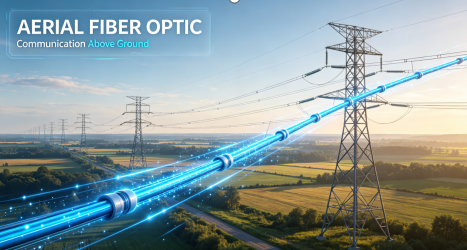
In our daily perception, communication optical fibers are mostly buried deep underground and hidden in pipes, being low-key and concealed. But in fact, in vast rural areas, remote mountainous regions, river wetlands and urban fringes, there is a kind of optical fiber suspended in the air, spanning streets, alleys, mountains and fields, quietly supporting the majority of network coverage. It is overhead optical fiber (overhead optical cable).
As one of the core forms of outdoor communication infrastructure, overhead optical fibers, with their advantages of low cost, fast construction and strong adaptability, have become the main force in the construction of the last-mile network, private network communication and power communication. Today's article will comprehensively disassemble overhead optical fibers in plain language, helping you understand their principles, classifications, advantages and disadvantages, as well as applicable scenarios.
Overhead optical fiber, also known as overhead optical cable, is an outdoor optical fiber cable that is suspended and laid in the open air relying on support facilities such as utility poles, iron towers, and brackets. It is different from underground laying methods such as underground burial, pipeline laying, and direct burial. It is one of the most commonly used laying forms of outdoor optical cables.
Its core structure is consistent with that of ordinary optical fibers, with glass optical fibers as the signal transmission core. The outer layer is equipped with dedicated reinforcing components, waterproof sheaths, and protective layers. It is specially adapted to complex outdoor environments such as sun exposure, wind and rain, temperature differences, and wind force. It can operate stably in a wide temperature range of -40℃ to +70℃, ensuring low-loss transmission of optical signals.
In simple terms: Underground optical fibers are "buried for passage", while overhead optical fibers are "routed in the air". There is no need to excavate the ground or lay pipelines; communication links are directly built relying on existing pole roads.
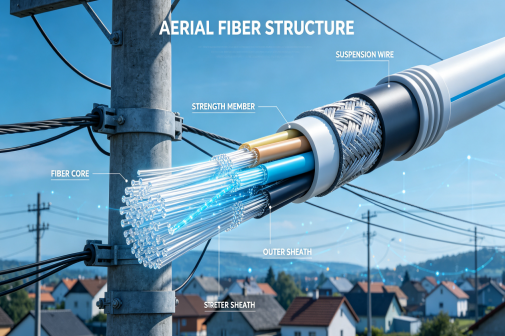
Overhead optical fibers are exposed outdoors for a long time and need to withstand tensile force, wind force, and erosion by rain and snow. Their structural design is more robust and durable than that of indoor optical fibers. They are mainly composed of four core parts:
• Optical fiber core wire: The communication core, responsible for transmitting data, voice and video signals in the form of optical signals, featuring fast transmission speed, low latency and strong anti-interference ability.
• Reinforced components: The core load-bearing structure, mostly made of materials such as steel wire and aramid yarn, significantly enhances the tensile and compressive strength of the optical cable, preventing the fiber from breaking due to suspended pulling.
• Protective sheath: Outer PE waterproof and weather-resistant sheath, which isolates rainwater, ultraviolet rays, wind and sand, acid and alkali corrosion, delays the aging of optical cables and extends their service life.
• Suspension wire/Load-bearing structure: Some overhead optical cables come with a suspension wire structure, which can be directly suspended and fixed. It is a key component for achieving suspended installation.
According to the load-bearing method, structural design and application scenarios, overhead optical fibers are mainly divided into four categories, covering the vast majority of communication engineering scenarios:
This is the most commonly used and cost-effective type in China. It does not have its own load-bearing structure. During construction, a load-bearing frame is built by attaching external steel strands, and then the optical cable is fixed to the steel strands with hooks and cable ties. It features a simple structure and convenient maintenance, making it suitable for short-distance and conventional span scenarios such as urban streets and alleys, and rural roads. It is compatible with the vast majority of civilian communication networks.
The shape is in the form of the number "8" structure. The upper part is the steel wire suspension load-bearing area, and the lower part is the optical fiber transmission area. It is integrally formed and does not require additional steel strand installation. It is lightweight and easy to install, suitable for medium and small span lines, and widely used in scenarios such as community networking, rural broadband, and surveillance networking.
The entire process is made of no metal material. It relies on its own aramid yarn reinforcing parts to bear all the tensile force, featuring excellent insulation and strong resistance to electromagnetic interference. It mainly focuses on large-span and high-voltage power peripheral scenarios, capable of crossing valleys, rivers, and high-voltage transmission lines, and is the mainstream choice for power communication dedicated networks.
The core design of the special overhead optical cable for power use, which serves two purposes in one. It has the dual functions of lightning protection grounding for overhead power ground wires and optical fiber communication transmission. It is directly erected on the top of high-voltage transmission towers without the need for additional vertical poles for wiring. It is mainly used for communication and security monitoring in the national power grid and high-voltage transmission trunk lines.
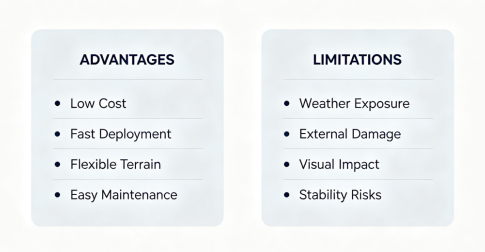
Underground optical fiber construction requires road excavation, pipeline laying, backfilling and repair, as well as land acquisition approval, which incurs extremely high costs. These procedures account for more than 50% of the underground wiring expenses. Overhead optical fibers rely on existing pole lines and do not require ground-breaking construction. The overall project cost can be reduced by 30% to 60%, making it the best solution for networking in remote areas.
Compared with the cumbersome construction process of underground wiring, the overhead optical fiber installation process is simple, not restricted by terrain or road surface, and the construction period is significantly shortened. It can quickly complete network construction, line emergency repair, and expansion and renovation, making it suitable for emergency communication, short-term networking, and full coverage projects in rural areas.
Whether it is mountainous, hilly, wetland, river course, or complex areas with abundant groundwater, rock geology and hardened road surfaces, overhead optical fibers can be easily set up, perfectly solving the pain points of difficult construction and skyrocketing costs of underground wiring.
The lines are suspended and exposed, making the fault points directly visible. Daily inspections, damage repairs, and line expansions do not require road excavation. The maintenance cost is low and the efficiency is high, significantly reducing the pressure on later operation and maintenance.
Overhead optical fibers are not flawless. The feature of being installed outdoors also brings inherent shortcomings, which is why they are rarely used in the backbone networks of core urban areas:
• Significant environmental impact: Long-term exposure to ultraviolet rays, wind and rain, ice and snow, and lightning, the aging speed is faster than that of buried optical fibers, and the service life is relatively shorter.
• Vulnerable to external force damage: High-altitude lines are prone to interference from strong winds, trees, construction machinery, and birds, leading to faults such as scraping, pulling, and breaking.
• Insufficient urban aesthetics: Dense overhead cables can affect the city's appearance. Large-scale overhead wiring is basically prohibited in core business districts, main roads, and newly-built urban areas.
• Slightly inferior transmission stability: Under extreme weather conditions, the lines are prone to shaking and deformation due to force. Compared with underground pipeline optical cables, the long-term transmission stability is slightly weaker and is not suitable for core backbone networks.
Combining the advantages and disadvantages, the application scenarios of overhead optical fibers are very precise and they are the "catch-up wonder tool" for communication infrastructure:
1.Broadband networking in rural and remote areas: The population in rural areas, towns and mountainous regions is scattered and the terrain is complex. The cost of underground construction is too high. Overhead optical fiber is the core solution for full coverage of rural networks.
2. Security monitoring networking: Line transmission for road monitoring, rural monitoring, and outdoor monitoring in parks, with fast construction and easy maintenance.
3. Power communication dedicated network: Relying on ADSS and OPGW special optical cables, it serves high-voltage transmission lines, communication in substations, and monitoring of power equipment.
4. Emergency and temporary networking: Disaster rescue, temporary events, and temporary construction site networks can be quickly set up and flexibly dismantled.
5. Suburban and industrial park branch line networks: Branch lines and access layer optical fiber lines in urban fringes, industrial parks, campuses, and residential areas.
Many people think that overhead optical fiber is a "low-end version" of optical fiber cabling, but in the communication infrastructure system, it has irreplaceable value.
Buried optical fibers support the high-speed network at the core of the city, while overhead optical fibers connect the communication blind spots in urban and rural areas, mountainous and remote regions. It enables network signals to cross mountains and seas at a lower cost and with higher efficiency, achieving full coverage of the entire network. It serves as the core carrier for inclusive communication, rural digitalization, and the construction of power private networks.
In a nutshell: The core urban area relies on underground networks, while remote areas rely on overhead networks. The two complement each other, which constitutes our ubiquitous high-speed network.

