


- All
- Product Name
- Product Keyword
- Product Model
- Product Summary
- Product Description
- Multi Field Search
Views: 0 Author: Site Editor Publish Time: 2026-04-16 Origin: Site

In the era of global supply chain digitalization, smart warehouses and logistics centers have become the core nodes connecting production, circulation and consumption. As the "neural network" of these intelligent facilities, cabling systems undertake the critical task of transmitting data, power and control signals, directly determining the operational efficiency, reliability and scalability of the entire logistics network. From the high-volume distribution centers in North America to the automated logistics hubs in Europe, and the smart warehouse clusters in Asia, cabling design must adapt to diverse regional needs, comply with international standards, and keep pace with technological innovations such as the Internet of Things (IoT), artificial intelligence (AI) and 5G. This article explores the key principles, global practices, technical challenges and future trends of cabling design for smart warehouses and logistics centers from an international perspective.
The fundamental goal of cabling design for smart warehouses and logistics centers is to build a stable, efficient, flexible and future-proof infrastructure that supports the seamless operation of various intelligent equipment—including automated guided vehicles (AGVs), stacker cranes, IoT sensors, RFID scanners, and warehouse management systems (WMS). Regardless of geographic location, the design must adhere to three core principles, while adapting to regional differences in regulations, climate and industry needs.
International standards are the cornerstone of standardized cabling design, ensuring that systems from different regions and manufacturers can interoperate. The ISO/IEC 14763-2 standard, which is equivalent to the updated GB/T 34961.2-2024 in China, provides a global framework for cabling planning and installation, emphasizing support for high-speed networks, intelligent systems and future expansion. In addition, standards such as TIA/EIA-568-C (North America) and EN 50173 (Europe) specify technical requirements for cable performance, routing, and termination, covering categories of unshielded twisted pair (UTP) cables (Cat6A, Cat7), fiber optic cables, and their supporting components.
For example, Cat6A cables, which support 10Gbps transmission, have become the minimum standard for smart warehouses globally, as they can meet the high-bandwidth needs of real-time data transmission from IoT devices and video surveillance. Fiber optic cables, especially bend-insensitive types such as G.657.A1 and G.657.A2, are widely used in backbone networks and long-distance connections due to their low loss, high bandwidth and immunity to electromagnetic interference (EMI), with high-fiber-count ribbon cables in growing demand to meet the needs of large-scale data center interconnection (DCI) in logistics hubs. Compliance with these standards ensures that cabling systems are compatible with global equipment and can be easily maintained and upgraded.
Smart warehouses and logistics centers vary significantly in size, layout and operational models across regions, requiring cabling designs tailored to specific scenarios. In North America, large-scale distribution centers (often over 1 million square feet) for global apparel brands require cross-border standardized cabling, supporting robotic pick towers, outdoor Wi-Fi coverage and large-scale CCTV systems, which often rely on fiber-to-the-edge solutions to overcome distance limitations.
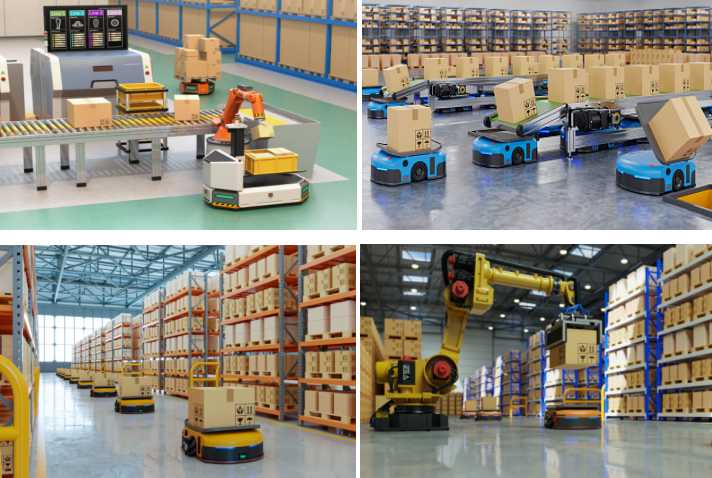
In Europe, where labor costs are high, fully automated warehouses with dense AGV fleets and collaborative robots demand cabling systems with high flexibility and redundancy to support 24/7 uninterrupted operation.
In Asia, especially in China and Southeast Asia, high-density smart warehouses supporting e-commerce logistics require cabling systems that can handle peak-period data surges, with modular designs to facilitate rapid expansion. Specialized scenarios such as cold-chain warehouses and pharmaceutical logistics centers also impose additional requirements: cabling materials must be low-smoke, halogen-free (LSZH) and resistant to extreme temperatures (-40℃ to +105℃), while meeting strict fire safety standards to protect goods and personnel. For example, stacker cranes in automated storage and retrieval systems (AS/RS) require high-flexibility trailing cables that can withstand millions of bends, integrate power, control and communication functions, and resist oil, dust and EMI.
The rapid development of technologies such as 5G, AI, and digital twins requires cabling systems to have sufficient scalability. A forward-looking design should reserve bandwidth and physical space for future upgrades—for instance, deploying fiber optic cables in backbone networks to support 5G small cells and high-definition (8K) video surveillance, and deploying 30% bandwidth in backbone links and 15%-20% redundant ports in horizontal cabling. Modular cabling design, emphasized in international standards, allows for easy addition or replacement of cables and components, adapting to changes in equipment and business needs without large-scale reconstruction. This is particularly important for cross-border logistics networks, where standardized modular design enables consistent infrastructure rollouts across multiple sites.
Cabling design for smart warehouses and logistics centers reflects regional technological preferences, regulatory requirements and industry focuses. By analyzing typical cases from different regions, we can gain insights into global best practices and their adaptability.
North American logistics centers, characterized by large scale, high automation and cross-border operations, prioritize scalability and standardized management. A leading global apparel retailer partnered with CaTECH Systems to deploy integrated cabling and network infrastructure across 5 high-volume distribution centers in the U.S. and Canada, spanning new builds and temporary facilities. The project faced challenges such as cross-border union regulations, permitting differences and complex logistics coordination, which were addressed through regional project managers and local leads, ensuring consistent quality across jurisdictions.
To overcome the distance limitations of outdoor Wi-Fi and surveillance in large facilities, the project adopted Corning’s fiber-to-the-edge solution, extending connectivity over half a kilometer without additional intermediate distribution frames (IDFs) or power infrastructure. The cabling system integrated structured cabling, fiber deployments, and support for robotic pick towers, with strict quality control including manufacturer-certified terminations and electrical safety inspections. This case demonstrates the importance of cross-border coordination and innovative fiber solutions in North American smart logistics cabling.
European countries have strict requirements for environmental protection and electromagnetic compatibility (EMC), which are fully reflected in cabling design. Smart warehouses in Germany, France and the Netherlands often adopt LSZH cables to reduce environmental pollution and fire hazards, in line with the EU’s RoHS and REACH directives. In addition, due to the dense deployment of industrial equipment (such as high-power motors and frequency converters) in European logistics centers, cabling systems must have strong EMI resistance.
For example, a smart logistics center in Germany, specializing in automotive parts distribution, uses a "total shielding + pair shielding" double-layer shielding structure for its cabling system, with shielded Cat7 cables and fiber optics to isolate EMI from nearby manufacturing equipment. The design also incorporates energy-saving concepts, using low-power components and optimizing cable routing to reduce signal loss and energy consumption. This aligns with Europe’s focus on sustainable development and high-reliability operations.
Asia’s smart warehouse development is driven by the booming e-commerce industry, with a focus on rapid deployment, high density and cost-effectiveness. In China, many e-commerce logistics hubs adopt a three-tier architecture (core layer, aggregation layer, access layer) for cabling, similar to the design used in cultural projects, to achieve efficient network traffic forwarding and business isolation. BIM (Building Information Modeling) technology is widely used to optimize routing, ensuring the concealment and maintainability of cabling while avoiding conflicts with building structures.
A large smart warehouse in Shenzhen, China, which handles millions of orders daily, uses a hybrid cabling system of Cat6A UTP cables and single-mode fiber optics. Cat6A cables are deployed in the access layer to connect IoT sensors and AGVs, while fiber optics form the backbone to support high-speed data transmission between the WMS and cloud platforms. The system also uses intelligent cabling management to monitor cable status in real time, reducing maintenance costs.
In Southeast Asia, where climate conditions are hot and humid, cabling materials are selected for moisture resistance and high-temperature tolerance, ensuring stable operation in harsh environments.
Despite the guidance of international standards and mature practices, cabling design for smart warehouses and logistics centers still faces global challenges such as EMI interference, harsh environment adaptation, and integration with diverse intelligent systems. Addressing these challenges requires technical innovation and rigorous design.
Smart warehouses are filled with high-power equipment (stacker cranes, AGVs, conveyors) that generate strong EMI, which can cause signal attenuation, delay or loss in cabling systems. This is a global challenge, especially in facilities with dense equipment deployment. The solution lies in a combination of cable selection and routing design: using shielded cables (STP, FTP) or fiber optics, which are immune to EMI; separating power cables and signal cables by a safe distance (at least 30cm) to avoid cross-interference; and adopting a double-layer shielding structure for critical links, such as the "aluminum foil wrapping + high-density tinned copper mesh braiding" used in stacker crane trailing cables, which achieves a shielding attenuation of ≥80dB. Proper grounding of shielding layers (single-end grounding for distances >30m, double-end grounding for ≤30m) also helps divert interference currents to the ground.
Logistics centers often face harsh environmental conditions, including extreme temperatures (cold-chain warehouses), humidity, dust, oil pollution and mechanical wear, which pose severe tests to cabling materials and structure.

Global solutions focus on material innovation and structural optimization: using polyurethane (PUR/TPU) sheaths, which are 10 times more wear-resistant than ordinary PVC, and can withstand extreme temperatures from -40℃ to +105℃, making them suitable for cold-chain and high-temperature environments. For mobile equipment such as AGVs and stacker cranes, high-flexibility cables with Class 6 ultra-fine stranded conductors and short-pitch layered stranding are used, achieving a dynamic bending life of over 10 million times, far exceeding the 1 million times of ordinary cables. In outdoor or semi-outdoor logistics yards, weather-resistant fiber optic cables with UV protection are deployed to prevent aging caused by sunlight and rain.
Integration with Diverse Intelligent Systems
Smart warehouses integrate multiple systems, including WMS, IoT, video surveillance, fire alarm and energy management, each with different cabling requirements. For example, IoT sensors require low-power, long-distance cabling (such as RS485 bus cables), while video surveillance requires high-bandwidth cables (Cat6A or fiber optics) to transmit 4K/8K video streams. The challenge is to design a unified cabling system that supports multiple protocols and signal types. The solution is to adopt a structured cabling system with a modular design, which separates the backbone and access layers, and uses standardized connectors (such as M12 industrial Ethernet connectors) to support plug-and-play of different devices. In addition, integrating intelligent cabling management systems enables real-time monitoring of cable status, fault diagnosis and resource management, improving the efficiency of system integration.
For global logistics enterprises with multiple warehouses across borders, ensuring consistent cabling standards and quality across sites is a major challenge, due to differences in regional regulations, construction teams and supply chains. Successful practices include appointing regional project managers and local leads to coordinate construction, pre-staging materials to ensure consistency, and adopting international standards (such as ISO/IEC 14763-2) to unify technical requirements. Single-source partners are often engaged to provide integrated solutions, covering cabling, electrical and network deployment, to avoid inconsistencies caused by multiple vendors.
With the continuous deepening of global supply chain intelligence, cabling design for smart warehouses and logistics centers is moving towards intelligence, greenization and full networking, driven by technological innovation and global environmental goals.
The integration of IoT and AI into cabling systems is becoming a global trend. Intelligent cabling management systems, equipped with sensors and data analytics, can monitor cable temperature, humidity, signal attenuation and connection status in real time, predicting potential faults and sending early warnings. This reduces maintenance costs and improves system reliability. For example, some advanced logistics centers in Europe and North America use AI algorithms to analyze cabling data, optimizing routing and resource allocation to reduce signal loss and energy consumption. In addition, digital twins technology is used to simulate cabling systems, enabling virtual design, testing and maintenance before physical deployment, improving design efficiency and reducing construction risks.
Global environmental protection policies and the concept of sustainable development are driving the greenization of cabling design. More logistics enterprises are choosing environmentally friendly materials, such as LSZH cables that produce no toxic gases or heavy smoke when burned, and recyclable copper and fiber materials. In addition, optimizing cabling routing to reduce cable length, using low-power components, and adopting energy-saving testing methods (such as passive optical networks) help reduce energy consumption and carbon emissions. This trend is particularly prominent in Europe and North America, where carbon neutrality goals are driving enterprises to adopt green cabling solutions.
The popularization of 5G technology is promoting the full networking of smart warehouses, with cabling systems supporting seamless connection between wired and wireless networks. Fiber optic cables, as the backbone of 5G networks, are being deployed to the edge of the warehouse, supporting 5G small cells and enabling high-speed, low-latency communication for mobile devices such as AGVs and drones. In addition, the integration of time-sensitive network (TSN) technology into cabling systems ensures deterministic low latency for critical control signals, supporting real-time coordination between automated equipment. This trend is accelerating the transformation of global logistics centers towards fully automated, unmanned operations.

Cabling design for smart warehouses and logistics centers is a global task that requires adherence to international standards, adaptation to regional characteristics, and response to technological innovation. From the cross-border distribution centers in North America to the e-commerce-driven warehouses in Asia, and the sustainable logistics hubs in Europe, cabling systems play a crucial role in supporting the efficiency, reliability and scalability of intelligent operations. By addressing challenges such as EMI interference, harsh environment adaptation and cross-border standardization, and embracing future trends of intelligence, greenization and full networking, cabling design will continue to empower the global smart logistics industry, promoting the digital transformation of the supply chain and creating more efficient, sustainable and resilient logistics networks.

