


- All
- Product Name
- Product Keyword
- Product Model
- Product Summary
- Product Description
- Multi Field Search
Views: 0 Author: Site Editor Publish Time: 2026-03-04 Origin: Site
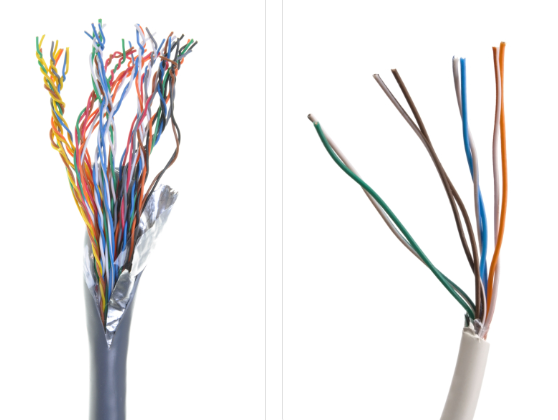
In the ever-evolving world of networking technology, choosing the right cabling infrastructure is crucial for ensuring reliable data transmission, especially as we push the boundaries of speed and connectivity in 2026. With the rise of 5G integration, IoT proliferation, and the demand for ultra-high-speed networks supporting 40Gbps and beyond, twisted pair cables remain a cornerstone of Ethernet setups. But within this category, the debate between shielded twisted pair (STP) and unshielded twisted pair (UTP) cables continues to be a hot topic for IT professionals, network engineers, and even home users upgrading their setups.
Twisted pair cables, as the name suggests, consist of pairs of insulated copper wires twisted together to minimize electromagnetic interference (EMI) and crosstalk. This design has been a standard since the early days of networking, but the addition—or absence—of shielding layers differentiates STP from UTP, impacting performance, cost, and application suitability. In 2026, with advancements in cable categories like Cat8 and beyond, understanding these differences is more important than ever. Factors such as environmental noise, data rates, installation complexity, and budget play pivotal roles in decision-making.
This blog post dives deep into the nuances of STP and UTP cables, exploring their technical foundations, pros and cons, and real-world scenarios where one outperforms the other. Whether you're setting up a smart home in Tokyo, managing a data center, or planning industrial automation, we'll guide you on when to choose each type. By the end, you'll have a comprehensive understanding to make informed choices that future-proof your network. We'll also touch on emerging trends, like the integration of Power over Ethernet (PoE++) and the push toward sustainable cabling solutions.
Let's start by breaking down the basics.
What is Twisted Pair Cable?
Twisted pair cabling is the most common type of network cable used in Ethernet networks today. It traces its roots back to the late 19th century when Alexander Graham Bell invented it to reduce interference in telephone lines. In modern networking, twisted pair cables carry data signals over copper wires, twisted in pairs to cancel out electromagnetic interference from external sources and between the pairs themselves.
Each cable typically contains four pairs of wires, color-coded for easy identification: orange/white-orange, green/white-green, blue/white-blue, and brown/white-brown. The twisting rate varies, with tighter twists providing better protection against noise. Categories like Cat5e, Cat6, Cat6a, Cat7, and Cat8 define performance levels, with higher categories supporting faster speeds and longer distances. For instance, Cat8 cables can handle 40Gbps over 30 meters, making them ideal for data centers in 2026.
The primary function of twisting is to create a balanced transmission line where induced noise affects both wires equally, allowing differential receivers to cancel it out. This is why twisted pair outperforms untwisted cables in noisy environments. However, as data speeds increase—to 10GBASE-T and higher—the limitations of basic twisting become apparent, leading to the development of shielding options.
In 2026, twisted pair cables are not just about connectivity; they're integral to smart ecosystems. With the global rollout of 6G prototypes and edge computing, these cables support everything from home automation to autonomous vehicles' backend systems. But the choice between shielded and unshielded variants hinges on environmental factors. Unshielded cables rely solely on twisting for noise reduction, while shielded ones add layers of foil or braiding for extra protection.
According to industry sources, twisted pair cables dominate over 90% of local area networks (LANs) due to their cost-effectiveness and ease of use. Yet, as we move toward more densely packed urban environments like Tokyo, where EMI from high-rise buildings and public transport systems is rampant, selecting the right type becomes a strategic decision.
Shielded Twisted Pair (STP) cables take the basic twisted pair design and enhance it with protective shielding to combat electromagnetic interference more effectively. The shielding typically consists of a thin foil wrapping around each pair (F/UTP or F/FTP) or an overall braid (S/FTP), sometimes combined for maximum protection. This conductive layer acts as a Faraday cage, absorbing and grounding external noise before it can disrupt the signal.
In technical terms, STP cables reduce alien crosstalk (ANEXT) and return loss, which are critical for high-speed applications. For example, in Cat7 and Cat8 cables, which are often shielded by default, the shielding ensures compliance with stringent standards like ISO/IEC 11801 Class F/A. The grounding requirement is key: the shield must be properly connected at both ends to a ground point to drain away induced currents, preventing them from becoming a source of noise themselves.
As shown in the diagram above, the foil shield or screen envelops the wire pairs, with an outer jacket providing additional insulation. This construction makes STP cables thicker and less flexible, but it's a trade-off for superior performance in harsh conditions.
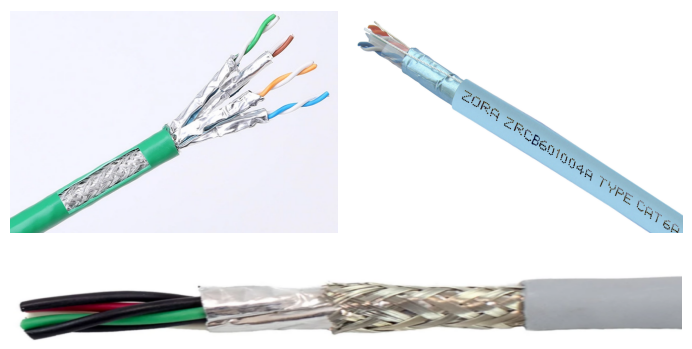
Advantages of STP include:
- Superior EMI/RFI Protection: Ideal for environments with high electrical noise, such as factories with heavy machinery or areas near power lines.
- Higher Data Integrity: Supports faster speeds over longer distances without signal degradation, crucial for 10Gbps+ networks.
- Reduced Crosstalk: The shielding minimizes interference between adjacent cables, beneficial in bundled installations.
- Durability: Often built with robust materials, making them suitable for outdoor or industrial use.
However, disadvantages are notable:
- Higher Cost: STP cables can be 20-50% more expensive due to additional materials.
- Installation Complexity: Requires careful grounding and specialized tools; improper installation can create ground loops.
- Bulkiness: Stiffer and heavier, making them harder to route in tight spaces.
- Limited Flexibility: Not ideal for frequent bending or mobile setups.
In 2026, STP is seeing increased adoption in sectors like healthcare, where MRI machines generate massive EMI, or in smart cities with dense sensor networks. Field tests indicate that STP outperforms UTP in high-interference settings, maintaining signal integrity where UTP fails.
Unshielded Twisted Pair (UTP) cables are the workhorses of everyday networking, relying exclusively on the twisting of wire pairs to mitigate interference. Without additional shielding, UTP is simpler in design: four twisted pairs encased in a PVC or plenum-rated jacket. This makes them lightweight, flexible, and easy to handle.
The effectiveness of UTP comes from the balanced twisting, where each pair has a different twist rate to reduce crosstalk. Categories like Cat6 and Cat6a enhance this with internal separators (spline) to keep pairs apart, improving performance up to 10Gbps over 100 meters. UTP cables don't require grounding, simplifying installation and reducing costs.
The illustration above depicts a typical UTP Cat6a cable, showing stranded twisted pairs, bare copper conductors, and a pair separator under a flexible jacket.

Key advantages of UTP:
- Cost-Effective: Significantly cheaper, making it accessible for large-scale deployments like office buildings or residential networks.
- Ease of Installation: Flexible and lightweight; no grounding needed, so DIY-friendly.
- Sufficient for Most Environments: Performs well in low-EMI settings, such as homes or small offices, where external noise is minimal.
- Wide Availability: Standard in most Ethernet applications, with vast compatibility.
Disadvantages include:
- Vulnerability to EMI: In noisy environments, signal quality can degrade, leading to packet loss or slower speeds.
- Shorter Effective Distance at High Speeds: More susceptible to attenuation in long runs.
- Crosstalk Issues: Without shielding, alien crosstalk can be a problem in dense cable bundles.
- Less Future-Proof: As speeds increase, UTP may require upgrades sooner in challenging setups.
In 2026, UTP remains dominant for consumer applications, powering smart homes and remote work setups. Its lower cost and simplicity make it ideal for the growing gig economy, where quick,affordable networking is key.
Advantages and Disadvantages: A Side-by-Side Comparison
To make the decision easier, here's a comparative table highlighting the key differences between STP and UTP:
Aspect | Shielded Twisted Pair (STP) | Unshielded Twisted Pair (UTP) |
EMI Protection | Excellent; foil/braid blocks external noise | Good; relies on twisting only |
Cost | Higher (20-50% more) | Lower; budget-friendly |
Installation | Complex; requires grounding | Simple; no special requirements |
Flexibility | Stiffer, less bendable | Highly flexible |
Best For | Industrial, data centers, high-EMI areas | Homes, offices, low-noise environments |
Speed Support | Superior for 10G+ over long distances | Adequate for up to 10G in ideal conditions |
Durability | More robust against physical and electrical stress | Standard; sufficient for indoor use |
This table underscores that while STP offers premium protection, UTP's simplicity wins in many scenarios. Costs can vary by category; for instance, a 100m Cat6 UTP roll might cost $50, while STP could be $80.
In 2026, with the explosion of data-intensive applications like AI-driven analytics and virtual reality, STP shines in environments where reliability is non-negotiable. Choose STP when:
1. High-EMI Environments: Factories, hospitals, or airports where motors, fluorescent lights, or radio signals generate noise. STP's shielding ensures stable 10GBASE-T connections.
2. Data Centers and High-Speed Networks: For 25G/40G Ethernet, STP reduces ANEXT in dense racks. With edge computing on the rise, STP supports seamless data flow.
3. Industrial IoT (IIoT): In smart factories, where sensors near heavy equipment need robust cabling, STP prevents downtime.
4. Long-Distance Runs: Over 55 meters at 10Gbps, STP maintains signal quality better.
5. PoE Applications: With PoE++ delivering up to 100W, STP handles heat and interference from power delivery.
Case study: A Tokyo manufacturing plant upgraded to STP Cat7 in 2025, reducing error rates by 40% amid robotic arms. In urban settings, STP is essential near subway lines or high-voltage grids.
However, ensure proper installation: Use shielded connectors and test for ground continuity to avoid issues.
UTP remains the go-to for cost-conscious, low-risk setups in 2026. Opt for UTP when:
1. Low-EMI Settings: Homes, small offices, or schools where noise is minimal. UTP Cat6a suffices for gigabit speeds.
2. Budget Constraints: For large installations like apartment complexes, UTP's lower price allows scalability.
3. Ease of Deployment: In retrofits or temporary setups, UTP's flexibility speeds up work.
4. Short to Medium Runs: Up to 100m at 1Gbps or 55m at 10Gbps, UTP performs reliably.
5. Consumer IoT: Smart homes with Wi-Fi extenders or streaming devices benefit from affordable UTP.
Example: Many Tokyo co-working spaces use UTP for their networks, saving costs while supporting remote workers. With advancements in twisting technology, modern UTP like Cat8 unshielded variants are emerging for niche uses.
Tips: Route UTP away from power cables and use quality terminations to maximize performance.
Looking ahead in 2026, the cabling landscape is shifting. The IEEE's push for 100GBASE-T over twisted pair will favor shielded designs for EMI control. Sustainability is key: Recyclable materials in UTP reduce environmental impact.
Hybrid solutions, like partially shielded cables, bridge the gap. With 6G and quantum networking on the horizon, expect smarter cables with embedded sensors for self-diagnosis.
Consider regulations: In Japan, EMI standards for urban areas may mandate STP in new builds. Budget for testing tools like cable certifiers to verify installations.
Ultimately, assess your environment: Conduct EMI surveys and factor in future upgrades.
Conclusion
Choosing between STP and UTP in 2026 boils down to balancing protection, cost, and application needs. STP excels in demanding scenarios, while UTP handles everyday reliability affordably. By understanding these, you can build networks that are efficient and future-ready. For personalized advice, consult a networking expert—your setup's success depends on it.

