


- All
- Product Name
- Product Keyword
- Product Model
- Product Summary
- Product Description
- Multi Field Search
Views: 0 Author: Site Editor Publish Time: 2026-03-26 Origin: Site
In structured cabling systems, twisted-pair cables have become the first choice for office networks, industrial control, security monitoring and other scenarios due to their low cost and easy deployment. However, crosstalk, the most common performance bottleneck, often causes network lag, packet loss, link instability, and even affects the normal operation of equipment. Today, we will break down the core issues of crosstalk — from identifying phenomena to locating root causes, and then to implementing solutions, allowing you to easily solve twisted-pair crosstalk problems.
In simple terms, crosstalk refers to the phenomenon where the electrical signal of one pair of wires in a twisted pair cable interferes with the adjacent pair due to electromagnetic coupling. It's like two people talking in adjacent rooms - their voices interfere with each other, making it hard to hear clearly - the same "signal crosstalk" occurs between the wire pairs in a twisted pair cable.
The twisted pair cable's twisting design is fundamentally aimed at eliminating this interference: the two wires are twisted in opposite directions, and the electromagnetic fields they generate cancel each other out, thereby reducing crosstalk. However, if the twisting structure is damaged or the wiring is not standardized, crosstalk will exceed the limit, affecting network performance.
NEXT (Near-End Crosstalk): Interference measured at the transmit end, the most impactful type for high-speed links. Caused by poor termination, excessive untwisting, or low-quality components.
FEXT (Far-End Crosstalk) :Interference measured at the far end of the cable, less severe than NEXT but still degrades long distance performance.
PSNEXT / ACRN / ELFEXT :Power-sum and equal-level crosstalk parameters used in certification testing to validate multi pair performance per TIA / ISO standards.
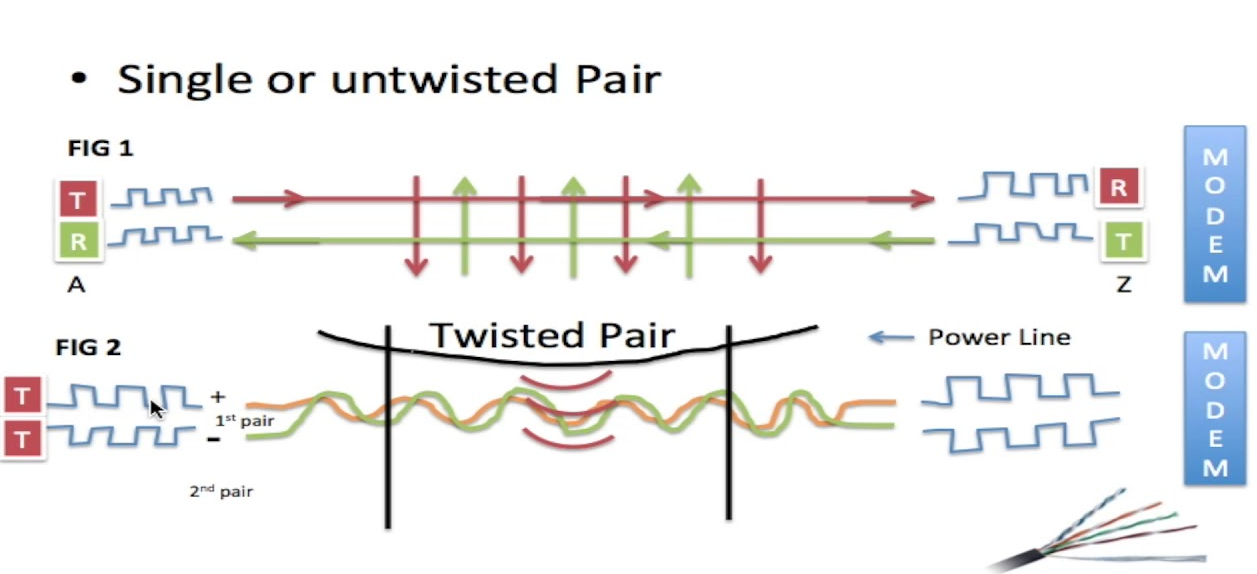
Interference does not occur randomly. If any of the following situations occur in the network, it is highly likely that interference is at play. A quick preliminary judgment can be made:
1. Unstable network: Frequent disconnections and port flapping, especially obvious stuttering and retransmission when transmitting large files or high-definition videos;
2. Substandard network speed: Obviously a Gigabit network cable, but the actual speed test is only 100Mbps or even lower. After ruling out router and network card problems, crosstalk should be prioritized;
3. Abnormal equipment: PoE-powered devices (such as surveillance cameras, wireless APs) restart frequently and have unstable power supply. Failures are more obvious in areas close to power cables;
4. Acceptance failure: When testing with a cable certifier (such as Fluke), parameters such as NEXT and return loss do not meet the standard, directly indicating excessive crosstalk.
After identifying the fault phenomenon, there is no need to blindly replace the cables. Instead, first investigate the following 6 most common causes. 80% of the crosstalk problems stem from these:
1. Excessive untwisting of pairs: The most common cause! When terminating crystal heads or modules, untwisting the twisted-pair pairs for more than 13mm (about 0.5 inches) will completely destroy the twisted anti-interference structure, leading to a sharp increase in crosstalk;
2. Split Pair: Incorrect pair assignment during wiring (such as pairing one wire of pair 1 with one wire of pair 2) destroys the balanced structure of the pairs, and crosstalk will directly exceed the standard;
3. Poor termination process: Loose crimping of crystal heads, irregular wiring of modules, leading to poor contact and abnormal impedance, which in turn causes crosstalk; using low-quality crystal heads and modules will also exacerbate crosstalk due to material problems;
4. Mismatched component grades: Mixing Cat5e cables with Cat6 crystal heads and modules will cause discontinuous link impedance, resulting in reflection and crosstalk;
5. External EMI: Parallel laying of twisted-pair cables with power cables (such as 220V power lines) at too close a distance, or being close to interference sources such as motors, frequency converters, and lamps, external electromagnetic signals will invade the pairs and cause crosstalk;
6. Physical damage to cables: Cables being crushed, over-bent, or the shielding layer of shielded twisted-pair (STP/FTP) being damaged or incorrectly grounded will damage the anti-interference ability and lead to excessive crosstalk.

After identifying the root cause, follow the steps below to quickly solve the crosstalk problem and ensure that the link meets the standards:
1. Instrument positioning to lock the fault end: Use a cable certifier (such as Fluke DSX) to test the link, confirm whether the crosstalk exceeds the standard at the near end (transmitting end) or far end (receiving end), and accurately lock the fault location to avoid blind troubleshooting;
2. Re-terminate and strictly control the untwisting length: For problems of excessive untwisting and poor termination, re-make crystal heads and wire modules, ensure the untwisting length ≤13mm, the twisted part is as close to the contact as possible, and the crimping is firm;
3. Correct the wire sequence and eliminate split pairs: Wire strictly in accordance with the T568A or T568B standard, ensure the wire sequence is consistent at both ends, and avoid split pairs and mixed wires;
4. Optimize wiring and stay away from interference sources: Adjust the cable route, keep a parallel distance of ≥30cm from power cables, and cross at 90°; stay away from interference sources such as motors and frequency converters, and avoid cables being squeezed or bent;
5. Unify component grades and replace inferior parts: Replace mixed components of different grades with the same grade (such as all Cat6 components), replace damaged cables, crystal heads, and modules, and give priority to qualified brand products;
6. Retest and accept to ensure compliance: After solving the problem, test again with a cable certifier to confirm that parameters such as NEXT and FEXT meet the corresponding category standards (such as Cat5e, Cat6) to ensure link stability.
Rather than addressing the issue after the fact, it is better to prevent it in advance. By following these steps, you can reduce the occurrence of crosstalk problems at the source and lower the maintenance costs in the long run:
- Pre-construction training: Train wiring personnel on termination technology, clarify the untwisting length and wire sequence standards, and avoid irregular operations;
- Choose qualified products: Cables, crystal heads, modules, jumpers and other accessories should be brand products that meet TIA/ISO standards, and components of different grades should not be mixed;
- Standardize wiring design: When planning the wiring route in the early stage, avoid strong electricity and interference sources, and reserve sufficient safety distance;
- Mandatory testing after completion: After wiring is completed, conduct a comprehensive test with a cable certifier, retain the test report, and do not accept if it does not meet the standard;
- Do a good job in daily maintenance: Regularly check whether the cables are damaged or squeezed, avoid pulling and bending the cables at will, and replace aging accessories in time.

Crosstalk in twisted-pair cables is not an insurmountable problem. Its core crux is almost concentrated on "irregular operations" and "inferior accessories". As long as you master the method of identifying crosstalk, accurately locate the root cause, and perform termination, wiring and testing in strict accordance with standards, you can completely eliminate crosstalk and make the twisted-pair link perform stably.
For enterprises and constructors, standardized construction and selection of qualified products in the early stage can not only reduce faults such as crosstalk, but also extend the service life of the cabling system and reduce later maintenance costs — this is the most efficient and worry-free solution.

