


- All
- Product Name
- Product Keyword
- Product Model
- Product Summary
- Product Description
- Multi Field Search
Views: 0 Author: Site Editor Publish Time: 2026-03-20 Origin: Site
Today in 2026, global data traffic is experiencing explosive growth. The demand for AI training clusters, 5G/6G backhaul, cloud data center interconnection, and transoceanic submarine cables has pushed optical communication into an unprecedented era of high speed. However, in the long-distance transmission (long-haul, typically ranging from tens of kilometers to thousands of kilometers) domain, single-mode optical fibers (Single-Mode Fiber, SMF) still firmly hold the dominant position, almost monopolizing the backbone networks of telecom operators, the core networks of the Internet, submarine cables, and ultra-long-distance data center interconnections (DCI). Although multi-mode optical fibers (Multi-Mode Fiber, MMF) still have advantages in short-distance scenarios in data centers, they are hardly seen in the long-distance field. This is not by chance; it is the result of the joint influence of physical principles, economics, technical compatibility, and the industrial ecosystem.
To understand the dominance of single-mode fibers, one must start with the physical structure of the fibers. Fibers consist of a core (Core), a cladding (Cladding), and a coating layer. Light signals propagate through total internal reflection within the core.
The core diameter of single-mode fibers is only 8-10 micrometers (μm), while the cladding diameter is 125 μm. It allows only one optical mode (the fundamental mode) to propagate, and the light travels almost in a straight line with almost no mode dispersion. Typical representatives include ITU-T G.652.D (standard single-mode), G.655 (zero dispersion shift), or the popular G.654.E (ultra-large effective area ultra-low loss fiber) in 2026.
In contrast, the core diameter of multi-mode fibers is 50 μm or 62.5 μm, and it can support hundreds of modes of propagation simultaneously. Light travels along different paths and at different speeds, resulting in mode dispersion (Modal Dispersion), and the signal rapidly distorts over long distances.
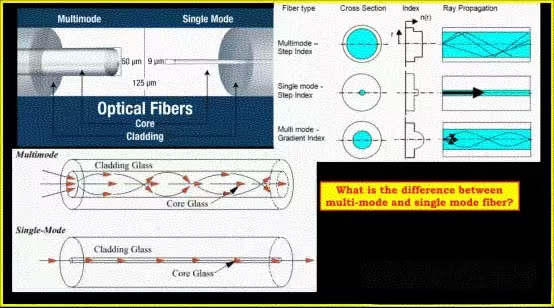
The above figure clearly shows the differences in cross-section, refractive index distribution, and light propagation path between single-mode and multi-mode optical fibers. In single-mode fibers, light travels in a straight line, while in multi-mode fibers, it jumps like a "ball bearing". This is precisely the fatal weakness of long-distance transmission.
The light source used in single-mode fibers is a narrow-spectrum laser (DFB or external cavity laser), while multi-mode fibers commonly use inexpensive LEDs or VCSELs. This also determines that single-mode is more suitable for precise long-distance systems.
The core challenges of long-distance transmission are signal attenuation (Attenuation) and dispersion (Dispersion). Single-mode fibers excel in both aspects.
Standard single-mode fibers have an attenuation of only 0.2 dB/km at the 1550nm wavelength window (even G.654.E can be as low as 0.17 dB/km), while multi-mode fibers have an attenuation of up to 2-3 dB/km in the 850nm window, and even worse in the long-wavelength window. After 100km transmission, the attenuation of single-mode signals is only 20dB (which can be easily amplified by EDFA), while multi-mode has an attenuation of hundreds of dB, making it unusable in practice.
The mode dispersion of multi-mode causes the signal to become blurry within a few kilometers. Single-mode only has dispersion (Chromatic Dispersion) and polarization mode dispersion (PMD), which can be easily solved by dispersion compensation modules (DCM) or coherent receivers. In 2026, coherent optical modules can integrate dispersion compensation in the DSP to achieve non-electronic regeneration transmission over thousands of kilometers.
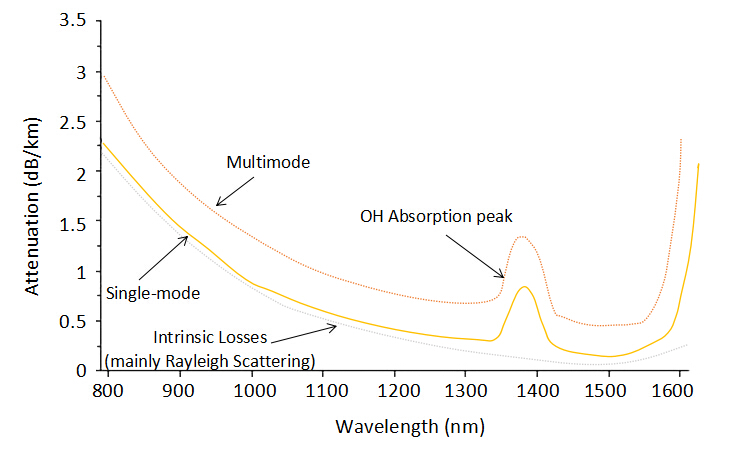
The above figure shows the typical attenuation curve of a single-mode optical fiber. The two low-loss windows at 1310nm and 1550nm are clearly visible. The 1550nm window, combined with EDFA (Erbium-Doped Fiber Amplifier), becomes the champion for long-distance communication. The multimode curve (orange) has high attenuation and significant water peak influence, making it unsuitable for long-distance communication.
Single-mode optical fibers support DWDM (Dense Wavelength Division Multiplexing), and a single fiber can carry hundreds of wavelengths. Each wavelength can be upgraded from 100G to 800G in 2026 or even 1.6T, and the total capacity easily exceeds 100Tbps. The distance can reach over 1000km without the need for electrical relays.
Multimode is limited by mode dispersion and bandwidth. It can only support short-distance 400G/800G and cannot effectively support DWDM. In 2026, OM5 multimode is still used within data centers, but for inter-city or inter-continental communication, single-mode must be switched.
Many people think that single-mode optical fibers are "expensive", but in long-distance scenarios, the opposite is true.
Initial deployment cost: The single-mode laser and transceiver are indeed 20-50% more expensive than the multi-mode ones, but the cost of optical cables per kilometer for long distances is extremely low.
Number of amplifiers and regenerators: For multi-mode, a regenerator is needed every 2-5 km, while for single-mode, only EDFA optical amplifiers (low cost, low power consumption, no need for photoelectric conversion) are required (80-120 km) for 80-120 km.
Market data for 2026: The market size of single-mode optical fiber cables is expected to reach 7.8 billion US dollars in 2026, with a CAGR of 6.5%-7.2%, far exceeding that of multi-mode. All 5G base station backhaul, AI data center interconnection, and submarine cable projects are specified to use single-mode. Although the price has risen temporarily due to AI demand (G.652D has increased from 18 yuan/km to 85-120 yuan/km), it stabilizes after supply chain expansion and still has cost-effectiveness in the long term.
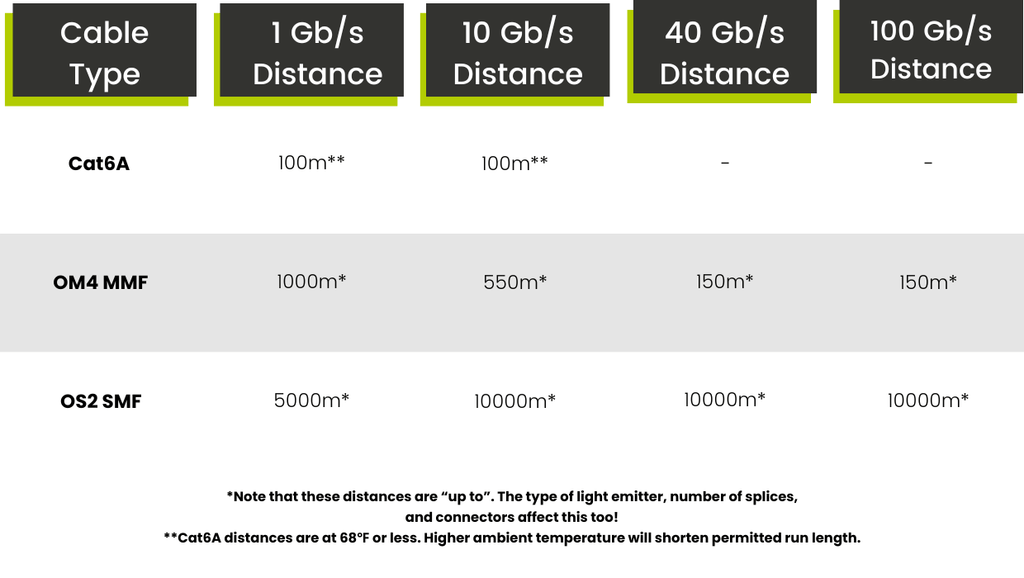
The above table shows the comparison of distances for single-mode vs multi-mode. OS2 single-mode easily supports distances of over 10km at 10G/40G/100G, while OM4 multi-mode can only support distances of several hundred meters. Deploying multi-mode over long distances will result in astronomical amplifier costs.
In 2026, long-distance networks are undergoing a "coherent revolution". Coherent optical transceivers (Coherent Optics) use advanced modulation techniques such as QPSK/16QAM, combined with DSP to compensate for dispersion and nonlinear effects, allowing both the capacity and distance of single-mode optical fibers to break through.
800G/1.6T era: Broadcom Tomahawk 5 and Nvidia Spectrum-4 switching chips drive the popularization of 800G ports. In 2026, the shipment of 1.6T modules is expected to explode, all based on single-mode OS2 or G.654.E optical fibers. ZR/ZR+ coherent modules support 120-200km without amplification, and ULH (ultra-long distance) modules support thousands of kilometers.
G.654.E ultra-low loss optical fiber: large effective area (125μm² vs G.652's 80μm²), reduces nonlinear effects, supports higher power and more wavelengths. In 2026, AI cluster DCI and submarine cable backbone will be widely adopted, with a span increase of 30-50%.
FlexGrid DWDM and ROADM: dynamic wavelength allocation, the capacity of a single fiber increases from 10Tbps to 50Tbps+, all relying on single-mode fiber cores.
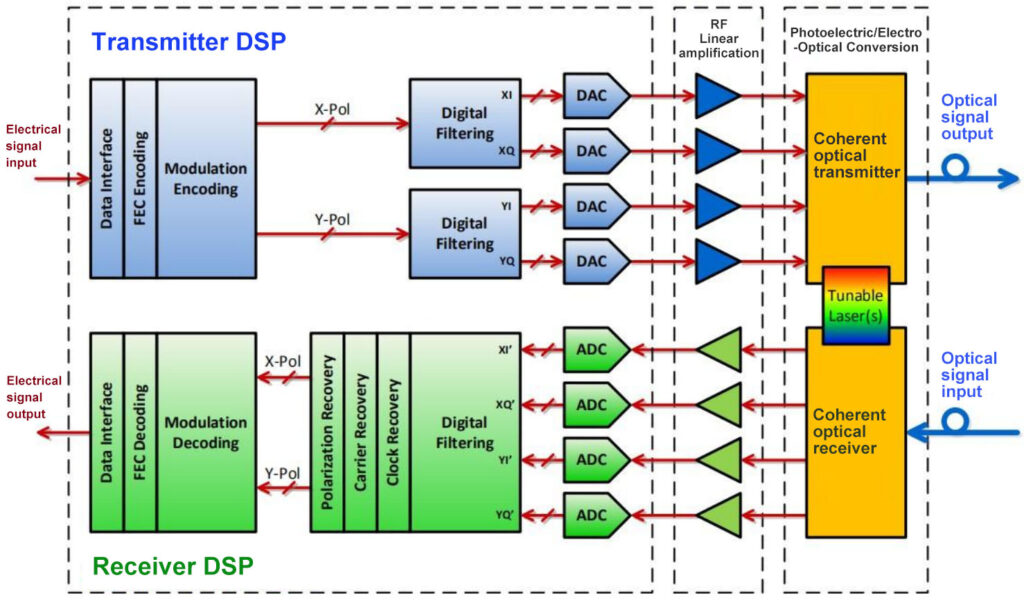
The above figure is a schematic diagram of the coherent optical communication system. The DSP processing at the transmitting and receiving ends enables single-mode optical fibers to achieve nearly "lossless" high-speed transmission over long distances, which is something that multimode fibers can never achieve.
The national backbone networks of China Mobile and China Telecom, as well as the intercontinental links of AT&T and Verizon in the United States, all adopt G.652/G.655 single-mode optical fibers + DWDM. Each single fiber can carry hundreds of Tbps, supporting the national internet traffic.
99% of the transoceanic data worldwide is transmitted through submarine cables. The internal fibers of all submarine cables (such as MAREA, PEACE, 2Africa) are all single-mode (G.654 series). One submarine cable can accommodate hundreds of pairs of fibers, with a total capacity of tens of Tbps. With a distance of tens of thousands of kilometers, only a few repeaters are needed.
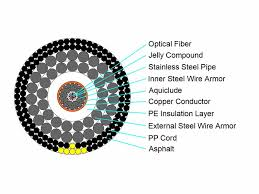
The above picture shows the cross-section of a typical submarine optical cable. The center is a bundle of multiple single-mode optical fibers, and the outer layer is steel wire armor for waterproof protection. Without single-mode, cross-ocean transmission cannot be achieved.
In 2026, the super-large AI clusters of Meta, Google, and Microsoft will interconnect across data centers (hundreds of kilometers) using single-mode + 800G coherent. G.654.E optical fiber makes the link loss lower and the capacity higher.
The backhaul links of base stations between cities (hundreds of kilometers) also have to use single-mode to ensure low latency and high reliability.
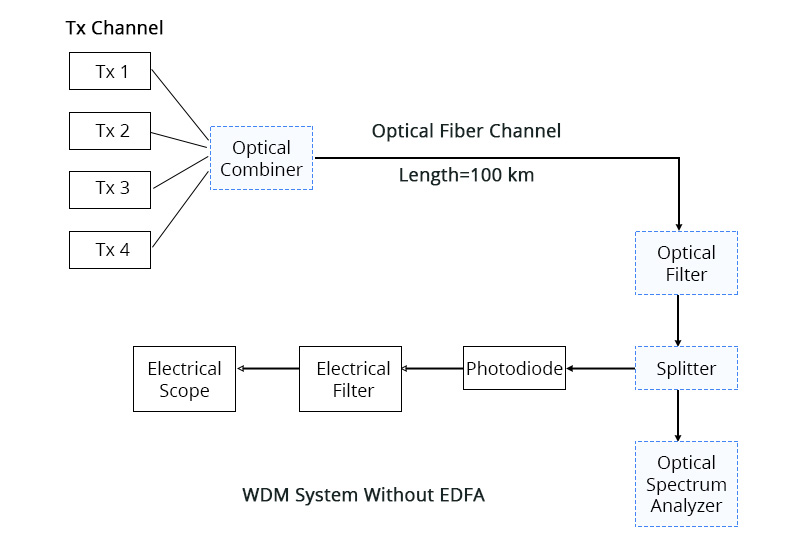
The above figure illustrates the architecture of the WDM long-distance transmission system (including optical fiber channels and filters), and on this basis, the real long-distance network adds EDFA and ROADM nodes.
The advantages of multimode fiber lie in low cost and easy installation (large core diameter has high tolerance). However, the fatal defect in long-distance transmission is:
Mode dispersion leads to a sharp decrease in bandwidth (the bandwidth of OM5 is insufficient after 550m).
It cannot support high-density wavelengths of DWDM.
The lifespan and power consumption of the laser are significantly inferior in long-distance scenarios.
The long-distance standards of 2026 (such as IEEE 802.3, ITU-T) all point to single-mode.
The consensus among the Reddit network engineer community is: "If a long-distance link is to be newly constructed, single-mode fiber must be used. Multi-mode fiber is only suitable for legacy short-distance renovations."
After 2026, single-mode will still be the mainstream. Hollow-Core Fiber or Multi-Mode Fiber (MCF) have been demonstrated in laboratories, but commercial deployment will at least occur after 2028, and it will still be based on the principles of single-mode. The bending-insensitive G.657 is only used in access networks, and long-distance still requires G.654.E.
In 2026, it is no coincidence that single-mode fiber dominates long-distance networks. It has become the only choice for telecommunications, submarine cables, and AI interconnection due to its extremely low attenuation, no mode dispersion, DWDM compatibility, coherent light support, and unparalleled TCO. Multi-mode fiber continues to shine in short-distance data centers, but the long-distance field has already been dominated by single-mode.
Whether you are a network engineer, an operator planner, or an investor, understanding this logic is crucial. In the future data flood, single-mode fiber will continue to carry the "spine" of human digital civilization.


