


- All
- Product Name
- Product Keyword
- Product Model
- Product Summary
- Product Description
- Multi Field Search
Views: 0 Author: Site Editor Publish Time: 2026-06-18 Origin: Site

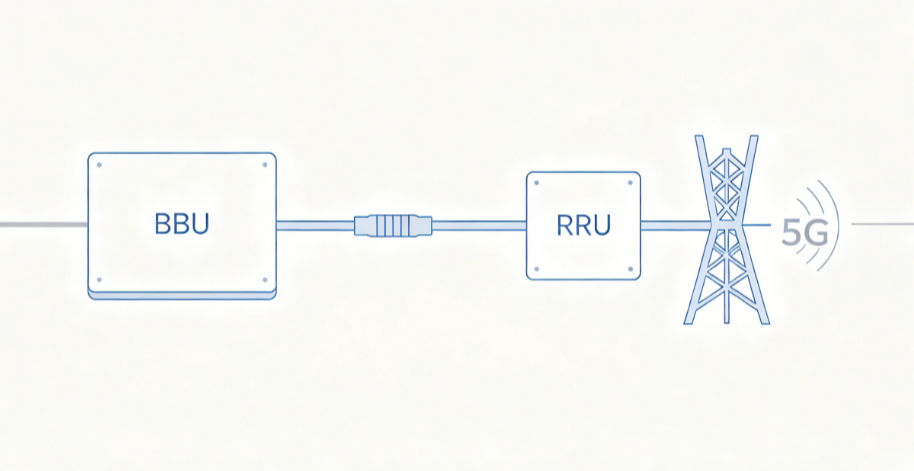
Fiber-to-the-Antenna (FTTA) is a mainstream radio access network architecture that deploys optical fiber cables from the baseband unit (BBU) to remote radio units (RRUs) and outdoor antennas. It replaces traditional coaxial cables, becoming the foundational transmission solution for modern mobile communication networks.
5G features high bandwidth, low latency and massive connection capacity. Macro base stations alone cannot meet dense coverage demands in urban areas, commercial districts, campuses and residential communities, so small cells are widely deployed.
Optical fiber supports ultra-high data rates to carry 5G massive signal traffic;
Fiber has low signal attenuation, suitable for distributed small cell layout;
Lighter and more flexible than coaxial cables, lowering construction and maintenance costs.
Traditional 4G networks mainly use coaxial cables for signal transmission. Coax suffers from high loss, limited bandwidth and heavy weight. FTTA takes optical fiber as the main medium, separating service signals and power supply links.
5G small cells are installed on street lights, building facades, billboards and other compact positions. FTTA cabling must adapt to outdoor miniaturized, scattered and densely distributed deployment scenarios, with stricter requirements on cable size, bending performance and environmental resistance.
FTTA needs to support CPRI/eCPRI protocol transmission, putting forward higher standards for transmission delay, jitter and link stability compared with legacy cabling systems.
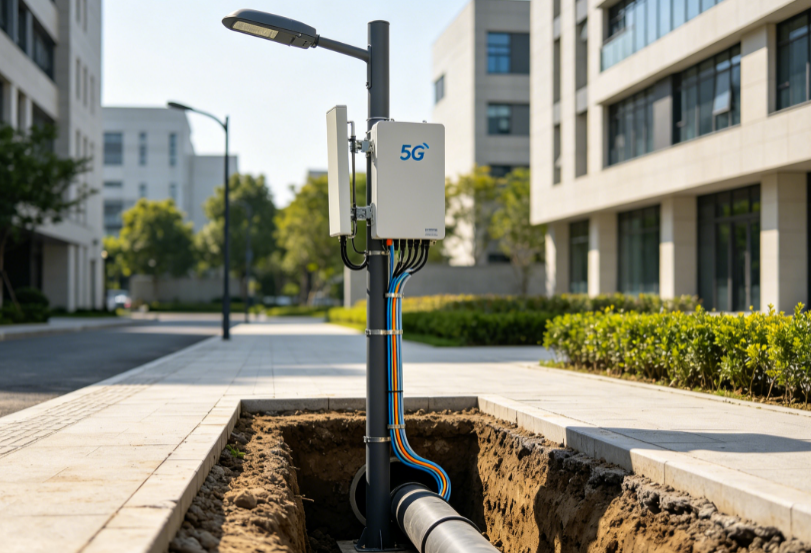
Fiber Type: Single-mode optical fiber is the standard choice for FTTA, matching long-distance and high-speed transmission of 5G signals. Common types include G.652D, G.657A1/A2, among which G.657 series with excellent bending resistance is preferred for small cells.
Cable Structure: Use miniature outdoor optical cables for small cells. Slim diameter, lightweight and good bending performance adapt to narrow installation spaces such as light poles and wall corners.
Mechanical Performance: Meet anti-compression, anti-tension and anti-torsion standards, to avoid fiber damage during laying and long-term operation.
Main connectors: LC, SC and MPO/MTP are widely used in FTTA systems. LC duplex connectors are mainstream for single small cell links; MPO/MTP multi-fiber connectors apply to multi-cell convergence scenarios for high-density wiring.
Insertion loss & return loss: Strictly controlled within industry thresholds to ensure no signal distortion in 5G high-frequency transmission.
Environmental adaptability: Outdoor connectors need dustproof, waterproof (IP65 and above) and anti-aging design.
Most 5G RRUs and small cell antennas adopt optical-electric hybrid cabling (FTTH hybrid cable or dedicated FTTA hybrid cable):
Integrate optical fiber and power copper wires in one cable, realizing signal transmission and power supply at the same time;
Separate signal and power cores structurally to prevent electromagnetic interference;
The power part meets outdoor low-voltage power supply specifications, adapting to long-term outdoor power supply for small cells.
5G small cells are exposed outdoors all year round, so FTTA cabling must pass rigorous environmental tests:
Temperature resistance: Adapt to -40℃ ~ +70℃ extreme temperature changes;
Weather resistance: UV resistance, rainproof, frost and hail resistance;
Anti-corrosion: Sheath material resists chemical corrosion in urban and suburban environments.
The standard FTTA link for small cells follows: BBU Room → Main Optical Cable Distribution Point → Distribution Cable → Small Cell RRU → Feeder Fiber → Antenna.
For densely deployed small cells, use tree topology for convergence wiring to simplify lines and facilitate later operation and maintenance.
Bending Radius: Follow fiber bending requirements. The minimum dynamic bending radius shall not be less than 10 times the cable diameter, static bending radius not less than 5 times, to prevent fiber breakage and increased loss.
Cable Routing: Along light poles, wall grooves or dedicated pipe trenches; avoid crossing high-voltage lines and strong electromagnetic equipment to reduce interference.
Fixation Protection: Use professional fixtures for fixation; exposed cables are protected by bellows or waterproof sleeves.
Calculate link attenuation in advance according to small cell coverage range. Control total fiber link length and joint loss to ensure CPRI/eCPRI signals transmit stably without packet loss or delay overrun.
Using ordinary indoor optical cables for outdoor deployment, leading to rapid aging and water ingress;
Excessive bending or pulling during laying, causing hidden fiber damage;
Unqualified connectors leading to excessive insertion loss and unstable 5G signals;
Mixed wiring of power and signal without isolation, resulting in electromagnetic interference.
Select dedicated outdoor FTTA cables and connectors for small cells, never mix indoor and outdoor products;
Standardize construction operations, strictly control bending radius and tension during laying;
Adopt pre-terminated fiber jumpers and connectors to reduce on-site splicing errors;
Plan wiring routes in advance, keep a safe distance from strong electricity and strong magnetic sources.
With the large-scale commercial use of 5G-A and the continuous densification of mobile networks, FTTA cabling will develop towards three directions:
High density & miniaturization: Smaller cables and high-density MPO wiring solutions adapt to more compact small cell deployment;
Integrated intelligent cabling: Combine monitoring sensors on cables to realize real-time remote monitoring of link status, temperature and loss;
Low-cost & easy maintenance: Modular prefabricated cabling becomes mainstream, shortening construction cycle and reducing later maintenance difficulty.
FTTA is the core wiring infrastructure for 5G small cell dense networking. Reasonable selection of optical cables, standard use of connectors, standardized laying construction and strict environmental protection are the keys to guarantee stable operation of 5G networks.
As 5G coverage continues to expand and next-generation mobile technologies evolve, FTTA cabling systems will keep upgrading to meet higher bandwidth, denser deployment and smarter operation demands, and support the stable development of the whole mobile communication network.

