
Views: 0 Author: Site Editor Publish Time: 2026-11-18 Origin: Site
Intro
One of the most frequent questions from cabling installers, system integrators and buyers: Must shielded twisted-pair cables (FTP / F/UTP / S/FTP / STP) be grounded? Can I install shielded RJ45 cables without grounding the shield?
Short answer: To make shielding work as designed, the shield layer must be properly bonded to ground. An ungrounded shielded cable acts like a floating antenna. Instead of rejecting EMI, it picks up electrical noise, causing packet loss, CRC errors, unstable 10G/40G performance, and may perform worse than regular UTP. However, grounding is not simply “connect both ends to earth”. Wrong grounding creates ground loops, which introduce far worse interference.
Chinese standard: GB 50311, GB/T 50328 require continuous shielding coverage and reliable shield termination & earthing for shielded structured cabling. Global standards: ISO/IEC 11801, ANSI/TIA-568.2-D, TIA-607-C specify that cable shields shall be bonded through shielded connectors, shielded patch panels and rack bonding buses to the Telecommunications Grounding Busbar (TGB). It focuses on equipotential bonding, not casual screw grounding.
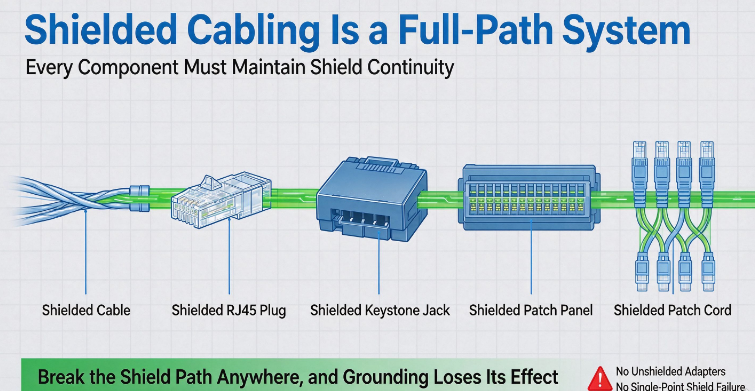
Critical rule: Shielded cabling is an end-to-end system: shielded cable + shielded RJ45 plugs + shielded keystone jacks + shielded patch panels + shielded patch cords. If one component is unshielded, the shield path breaks, and grounding becomes useless.
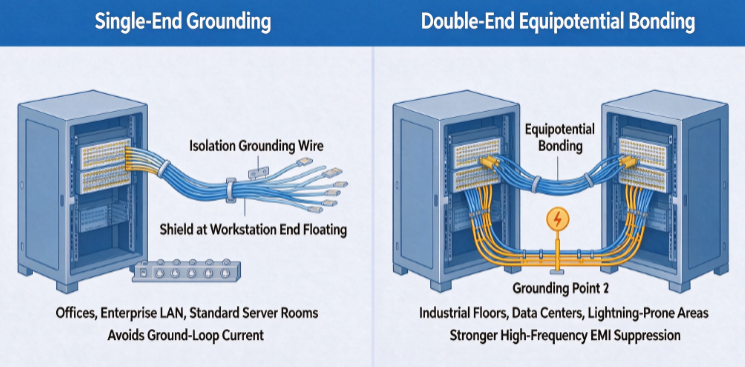
Bond the shield only at the patch panel / telecom room side; leave the workstation end shield floating.
Pros: Eliminates ground-loop current caused by earth potential difference. The most widely adopted method for Cat6A / Cat7 enterprise networks.
Limitation: Less effective against strong magnetic fields and high-frequency RF noise compared with double-end bonding.
Bond both ends of the shield to ground, only when both grounding points share the same equipotential plane with negligible potential difference.
Pros: Superior high-frequency EMI & RF suppression, ideal for Cat8, 40G links, Profinet and EtherNet/IP industrial Ethernet.
Risk: If two earth references are separated (different buildings, separate transformers), potential difference drives circulating current on the shield. Noise couples into twisted pairs, bringing random packet loss and intermittent links — the #1 root cause of industrial cabling faults.
Simple rule: Same building, same equipotential grid → double-end bonding allowed; separate earth systems across buildings → use single-end grounding only.
1. Myth: Crimping a shielded RJ45 plug means the cable is grounded. Fact: The metal shell only electrically connects the foil/braid shield. If the switch chassis itself is not bonded to building telecom ground, the shield remains floating.
2. Myth: A random earth wire from the residential distribution box works fine. Many domestic earth circuits are poorly installed with high resistance. If there is no heavy EMI source such as VFD, inverter or servo motor, UTP is usually a more stable and low-cost option.
3. Myth: The lower the grounding resistance, the better. Structured cabling prioritizes equipotential bonding over ultra-low resistance. Shared earth grid target ≤1Ω; isolated earth ≤4Ω, follow local electrical codes and project design.
4. Myth: Shield drain wire can be tied together with power protective earth arbitrarily. Shield bonding conductors should follow telecom bonding routes. Do not share heavy-load PE paths, which couples power noise into data circuits.
For short runs in regular offices and homes with no nearby VFDs, solar inverters, high-power motors or radio transmitters: Unshielded UTP is simpler, cheaper and maintenance-free with no grounding hassle. Shielded cabling is a targeted solution for harsh EMI environments, not a mandatory upgrade for all high-speed networks.
Full continuity of shield foil/braid and drain wire from plug to jack to patch panel
Keep stripped shield length minimal to reduce leakage apertures
Use short, thick, straight bonding conductors to minimize impedance
Confirm grounding topology (single / double end) matches site equipotential condition
Post-install Fluke DSX certification: test shield continuity, NEXT, return loss, not just continuity test
Shielded Ethernet cables do not block noise automatically. Proper grounding / bonding closes the shielding loop.
No ground = shield turns into an antenna.
Improper dual grounding = ground loop noise.
Evaluate EMI environment and building grounding quality before specifying shielded links, and choose single-end or double-end bonding accordingly. High-speed Cat6A, Cat7 and Cat8 links are extremely sensitive to shield discontinuity and poor bonding; grounding defects easily cause bandwidth failure and fail certification.


