
Views: 0 Author: Site Editor Publish Time: 2026-11-12 Origin: Site
It's not a switch. It's not a patch panel. It moves zero bits.
Yet it makes your rack cleaner, cooler, and far less chaotic.
Walk into any data center or network closet, and you'll see them everywhere—empty U-spaces, cables dangling from open gaps, dust collecting on equipment faces. Most engineers focus on the "smart" gear: switches, servers, PDUs. But there's a humble 1U panel that quietly solves three problems at once.
This is the story of the Brush Guard Panel.
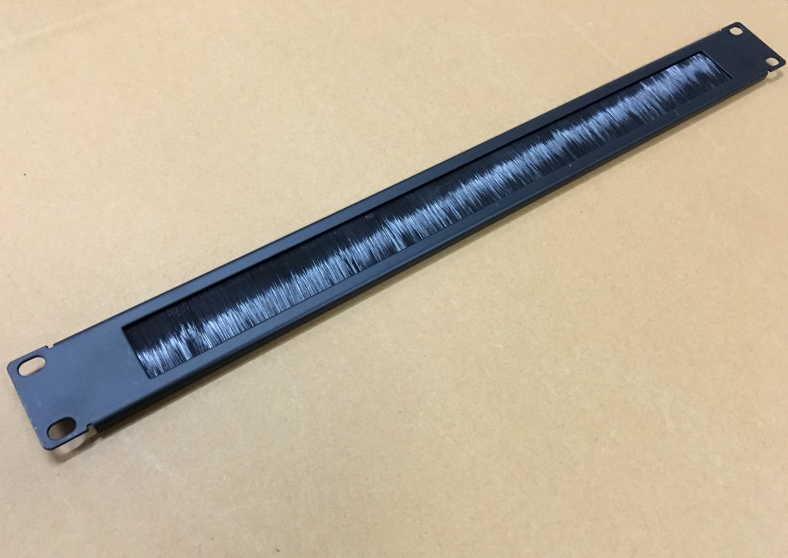
A Brush Guard Panel is a standard 19-inch, 1U rack panel: a metal frame filled with dense nylon bristles, mounted in empty rack spaces or cable entry points.
· Cables pass through the bristles
· Empty U-slots stay covered
· Dust, cable mess, and airflow bypass are all controlled at once
Think of it as a "bristled curtain" for your rack—open enough for cables, closed enough for everything else.
Item | Blank Panel | Brush Guard Panel |
Seals empty U-space | ✓ | ✓ |
Allows cable pass-through | ✗ Requires panel removal | ✓ Flexible bristle pass-through |
Dust protection | Strong | Medium (blocks floating dust) |
Hot/Cold aisle containment | Strong | Strong (reduces bypass airflow) |
Cable management | None | Yes |
A solid blank panel is great when no cable needs to pass. If even one patch cord crosses that slot, use a brush guard panel. It's the only accessory that seals and routes at the same time.
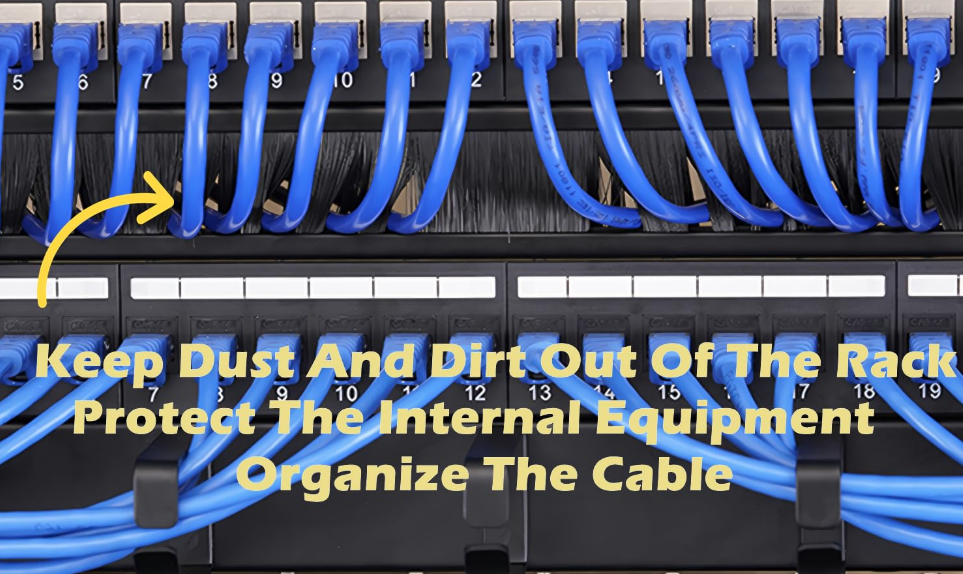
Patch cords exit as a neat bundle through the bristles—no sagging across switch ports, no blocked air intakes. Your gear stays cooler and looks professional.
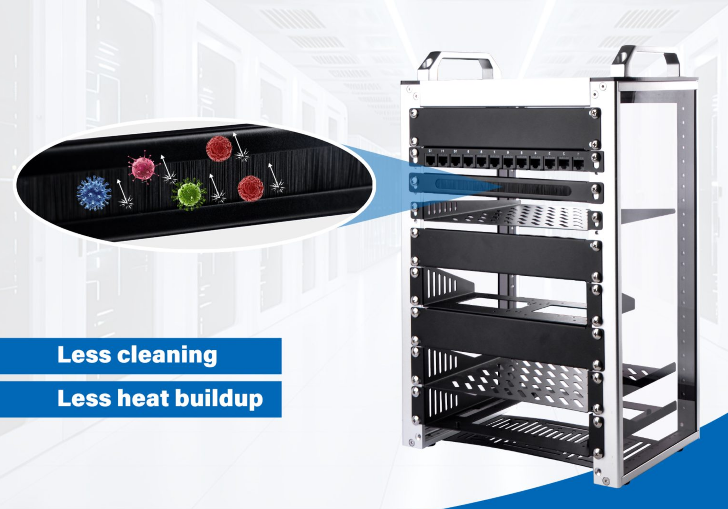
Open U-slots are invisible airflow leaks. They let cold air escape before reaching equipment and let hot exhaust recirculate. Brushes seal the gap so cold air goes through devices, not around them. In high-density racks, this can mean the difference between 25°C and 35°C intake temperatures.
Floating dust, fibers, and debris are stopped at the rack face. It's not a cleanroom seal, but it's dramatically better than leaving gaps open—especially in construction-adjacent or industrial environments.
When cables exit from a defined brush opening, groups stay separated: uplinks, access ports, PoE, fiber—each visible and traceable. No more "which cable goes where" guessing games during an outage.
Empty slots no longer expose internal equipment. From the aisle, the rack presents a clean, uniform front—the mark of a well-run facility, not a "spider web" closet.
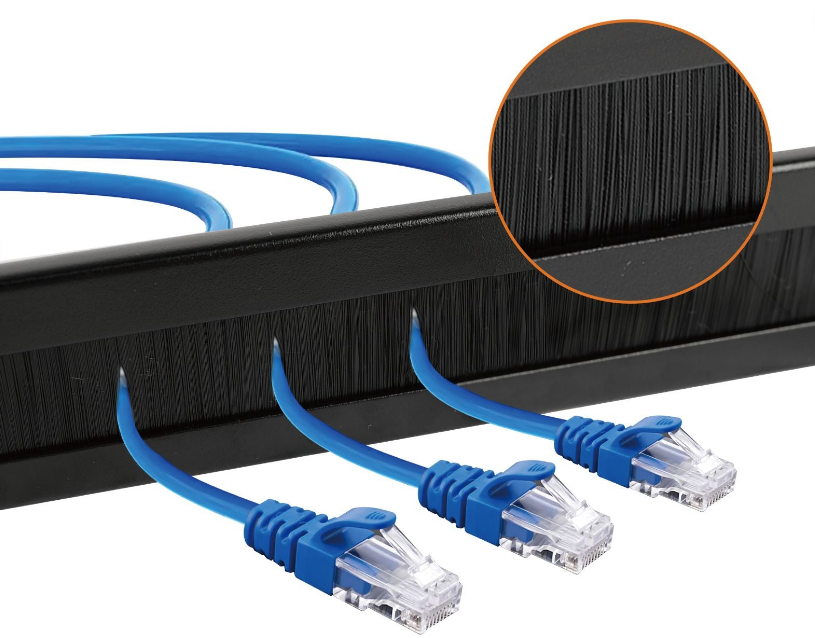
· Data center racks: Front and rear cable entry sealing, maintaining hot/cold aisle isolation
· Network IDF/MDF closets: Cable breakout between patch panels and switches
· CCTV/security racks: Separate routing for power and signal cables
· Office server rooms: Clean appearance for wall-mount and floor-standing cabinets
· AV/broadcast racks: Centralized management for mixed copper and fiber bundles
What to look for:
· Standard 19" EIA-310, 1U (or 2U for thick bundles)
· SPCC cold-rolled steel or aluminum frame, black powder coat
· Dense, low-shed, flame-retardant bristles (UL94 V-2 or better)
· Pre-punched mounting holes, M6/cage-nut compatible
· Available in "closed type" (full brush) or "one-side-open type" (partial opening)
Installation rule of thumb:
· No cable needs to pass → solid blank panel
· Cable must cross the slot → brush guard panel
· Don't over-compress the bristles; respect fiber bend radius (≥30mm)
· Don't exceed ~30 Cat6 cables per 1U panel to maintain seal integrity
Let's be clear about the limits:
· Not a firestop — cannot replace fire-rated caulk, putty, or fire barriers
· Not a sealed dust enclosure — it blocks floating debris, not fine particles under pressure
· Not a cooling device — it helps airflow efficiency, but adds no cooling capacity
· Not a full cable manager — for high-density horizontal cable organization, pair it with D-ring managers or horizontal cable managers
The brush panel is one layer in a complete rack discipline strategy, not a silver bullet.
A 1U brush guard panel might be the smallest line item on your BOM. But it quietly fixes four problems at once: cable order, dust ingress, airflow efficiency, and visual professionalism.
In mission-critical environments, the difference between "good enough" and "excellent" is rarely about the big-ticket gear. It's about the details—the U-slots you didn't ignore.
Good racks aren't built only with expensive gear.
They're built by managing every empty U with intent.


